
In an increasingly complex global economy, financial literacy is no longer just a helpful skill—it is a foundational requirement for long-term security and personal success. While traditional education systems excel at teaching individuals how to earn money, they rarely teach them how to manage, grow, and protect it. This fundamental gap leaves millions of capable professionals struggling with debt, inadequate savings, and deferred retirement, regardless of their income level.
Financial education transforms income into lasting wealth. Understanding core economic principles, investment dynamics, and risk management provides individuals with the tools necessary to navigate life’s financial milestones and unexpected challenges.
1. Bridging the Gap Between High Earning and Wealth Creation
A common misconception is that a high income guarantees financial stability. In reality, income is merely the top-line number; wealth is what remains after expenses, inflation, and taxes take their toll. Without financial literacy, increased earnings often lead to “lifestyle creep”—a phenomenon where spending expands in tandem with earnings.
- Cash Flow Management: Financial education instills the discipline of tracking cash flow rather than focusing solely on revenue.
- Capital Retention: Knowing how to allocate capital efficiently ensures that excess earnings generate compounding returns rather than disappearing into depreciating assets.
- Inflation Protection: Literate investors understand that cash sitting dormant in traditional low-interest savings accounts actively loses purchasing power over time.
2. Navigating the Psychology of Money and Decision-Making
Financial literacy extends beyond spreadsheets and math; it heavily influences human psychology and decision-making. Behavior, habit, and emotion drive financial outcomes far more than technical formulas do.
- Mitigating Emotional Impulse: Educated individuals are less prone to emotional market reactions, such as panic-selling during economic downturns or buying risky speculative assets due to the fear of missing out (FOMO).
- Delayed Gratification: Understanding the mathematical power of compound interest reframes how one views short-term sacrifices versus long-term security.
- Risk Appraisal: Financial education enables clear-eyed risk assessment, allowing individuals to distinguish between calculated financial risks and reckless gambling.
3. The Core Pillars of Financial Competence
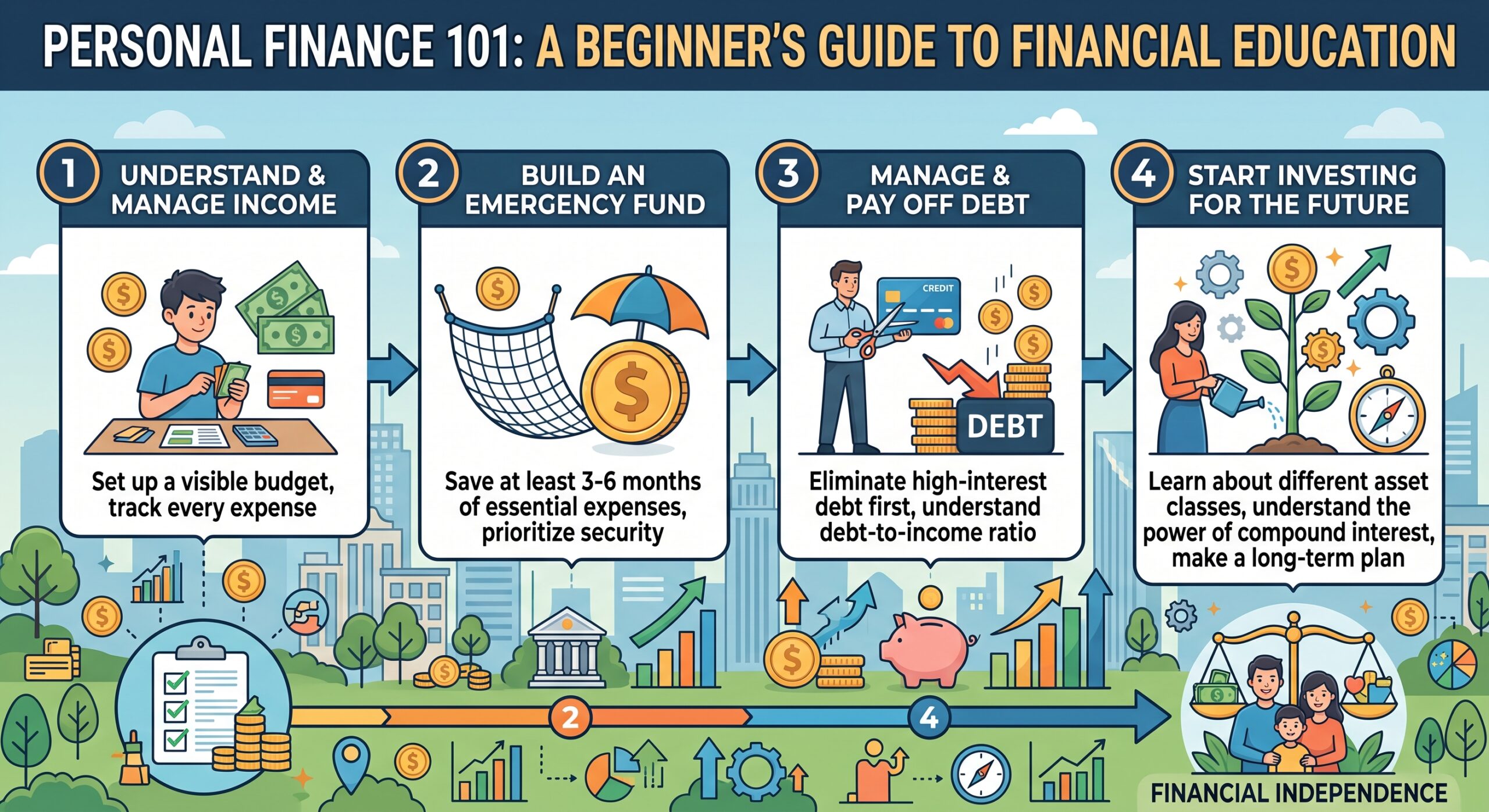
Achieving true financial independence requires mastery over four main domains:
| Pillar | Focus Area | Core Objective |
| Budgeting & Cash Flow | Income tracking & expense allocation | Maintaining a consistent, deliberate surplus every month. |
| Debt Management | Interest rates, leverage, and credit score optimization | Eliminating high-interest consumer debt while leveraging low-cost debt strategically. |
| Investing & Wealth Building | Asset allocation, index funds, diversification, real estate | Harnessing compounding interest to build passive long-term equity. |
| Risk Management & Protection | Emergency funds, insurance policies, estate planning | Safeguarding assets against unexpected health issues, market crashes, or legal liabilities. |
4. Mitigating Systematic Risk and Securing Retirement
Relying solely on state-sponsored pensions or standard employer retirement programs is becoming increasingly risky. Shifting demographic trends and economic pressures mean that personal responsibility plays a far larger role in retirement planning today than it did for previous generations.
The Power of Compound Growth
Time is the single most valuable asset in financial growth. Consider the long-term impact of starting early due to basic financial education:
- Early Start (Age 25): Investing $300 a month at an average 8% annual return yields approximately $1,000,000 by age 65.
- Delayed Start (Age 35): Investing the exact same $300 a month under identical conditions yields roughly $440,000 by age 65.
This gap illustrates that waiting ten years cuts the final retirement fund by more than half, demonstrating that early financial education directly translates into exponential monetary value.
5. Fostering Mental Well-being and Professional Freedom
Financial strain is widely recognized as one of the primary drivers of chronic stress, anxiety, and relationship breakdown. Financial literacy directly counters these pressures by providing control and predictability over one’s life choices.
- Career Flexibility: Financial stability creates an emergency reserve, granting individuals the freedom to pivot careers, pursue entrepreneurship, or leave toxic workplace environments without facing immediate insolvency.
- Reduced Stress: Knowing that unexpected medical bills or vehicle repairs will not disrupt basic living conditions dramatically lowers daily stress levels.
- Autonomy and Independence: Financial self-sufficiency prevents dependency on external entities, employers, or family members for basic survival needs.
6. Practical Steps to Build Personal Financial Literacy
Building financial competence is a continuous process rather than a static goal. Developing strong financial acumen involves several practical strategies:
- Audit Existing Finances: Track every expense for 30 to 90 days to identify spending patterns and locate hidden leaks in personal cash flow.
- Read Foundational Literature: Engage with established literature on behavioral economics, personal finance, and classic investing principles.
- Automate Savings and Investments: Set up recurring transfers on payday to treat savings as a non-negotiable expense rather than a leftover surplus.
- Understand Tax Efficiency: Familiarize yourself with tax-advantaged accounts (such as 401(k)s, IRAs, ISAs, or local equivalents) to maximize retained earnings legally.
Sustaining Long-Term Independence
Financial education is not merely about accumulating currency; it is about acquiring agency, time freedom, and security. In an evolving economic landscape marked by market volatility and technological disruption, understanding money management is the most effective safeguard an individual can construct. By mastering budgeting, managing risk, and committing to long-term investing principles, individuals transition from reacting to financial pressures to actively shaping their own long-term success.