Mastering your personal finances is one of the most impactful steps you can take toward long-term independence, reduced stress, and peace of mind. Financial literacy is not reserved for economists or high earners; it is a practical set of habits and principles that anyone can build from scratch.
Whether your goal is to eliminate debt, build a safety net, or invest for long-term growth, this foundational guide outlines the core pillars of personal finance.
1. The Foundation: Mindset and Budgeting
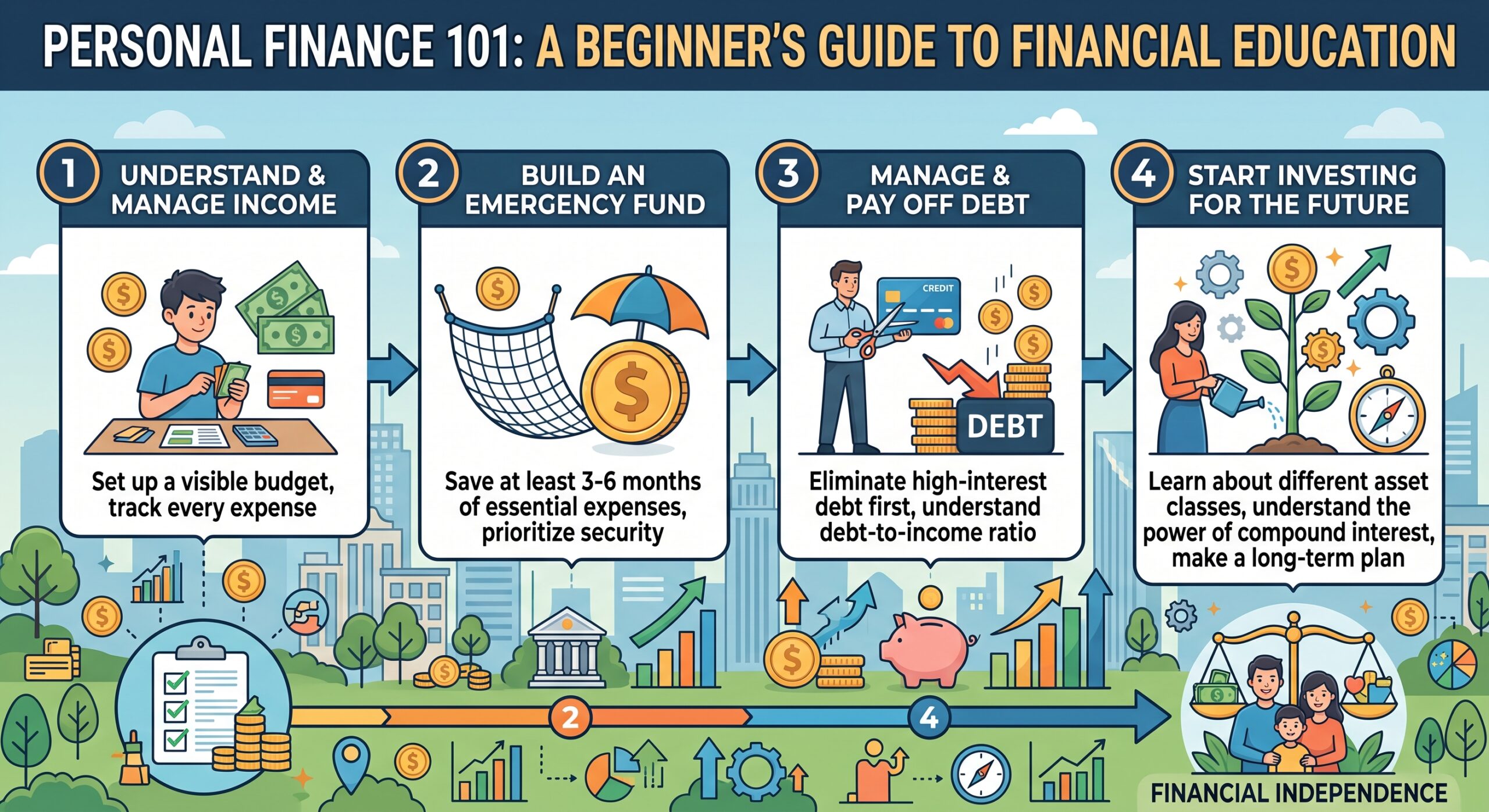
Before diving into spreadsheets, software, or investment accounts, financial success requires a clear understanding of cash flow: Income minus Expenses.
A common misconception is that budgeting is restrictive. In reality, a budget gives every dollar a purpose, shifting control back into your hands.
Popular Budgeting Frameworks
- The 50/30/20 Rule:
- 50% Needs: Essential living expenses (housing, utilities, transportation, groceries, basic healthcare).
- 30% Wants: Discretionary lifestyle spending (dining out, entertainment, hobbies, subscription services).
- 20% Savings & Debt Payoff: Extra payments toward high-interest debt, emergency savings, and investments.
- Zero-Based Budgeting: Allocates every single dollar earned to a specific category until the remaining unallocated balance equals zero.
- Pay Yourself First: Automatically transfers a fixed percentage of income directly to savings or retirement accounts immediately upon payday before paying regular bills or discretionary spending.
2. Establishing Your Safety Net: The Emergency Fund
Life is inherently unpredictable. Medical emergencies, unexpected home repairs, or sudden income disruption can derail long-term planning if you do not have liquid reserves.
How Much to Save
- Starter Fund: Begin by saving $1,000 as quickly as possible to handle small, unexpected hurdles without turning to credit cards.
- Full Emergency Reserve: Accumulate 3 to 6 months of essential living expenses in an easily accessible account.
Where to Keep It
Store emergency reserves in a High-Yield Savings Account (HYSA). HYSAs keep capital liquid while yielding significantly higher interest rates than standard traditional checking or savings accounts.
3. Tackling Debt: Strategies and Prioritization
Not all debt carries equal weight. Understanding the distinction between high-interest debt and lower-interest debt determines your priority list.
High-Interest vs. Low-Interest Debt
- High-Interest Debt: Usually credit cards or high-cost personal loans with interest rates above 8–10%. Eliminating high-interest debt offers a guaranteed, risk-free return on your investment equivalent to the interest rate avoided.
- Low-Interest Debt: Mortgages or low-rate student loans (often below 4–5%). While paying them down is important, prioritizing high-interest obligations yields better overall financial health.
Proven Debt Payoff Methods
- The Debt Avalanche Method: Pay minimum balances on all obligations, directing all extra cash to the debt with the highest interest rate. Mathematically, this saves the most money over time.
- The Debt Snowball Method: Pay minimums on all obligations, focusing extra funds on the smallest balance first. Eliminating small accounts quickly provides psychological momentum and motivation.
4. Investing for Long-Term Growth
Saving alone is rarely enough to build long-term wealth because inflation erodes the purchasing power of cash over time. Investing puts your capital to work, capturing compound growth over multi-decade horizons.
Compound Interest Impact Over Time
Asset Value = Principal × (1 + Rate)^Time
Key Investment Principles
- Compound Interest: The phenomenon where earnings generate their own earnings. The earlier you begin investing, the less total principal you need to contribute over a lifetime.
- Diversification: Spreading investments across various asset classes (equities, fixed income, real estate) reduces overall portfolio risk.
- Index Funds & ETFs: Low-cost index funds track major market indexes (such as the S&P 500), offering instant broad-market diversification without high active-management fees.
Account Types to Consider
- Tax-Advantaged Retirement Accounts: Vehicles such as employer-sponsored 401(k) plans or Individual Retirement Accounts (IRAs/Roth IRAs) offer significant tax benefits designed for long-term retirement planning.
- Standard Taxable Brokerage Accounts: Flexible investment accounts with no contribution limits or withdrawal penalties, though capital gains and dividends are taxed annually.
5. Protecting Your Wealth and Building Habits
Acquiring assets is only half the battle; safeguarding them is equally vital to long-term financial stability.
Essential Risk Mitigation
- Insurance Coverage: Ensure adequate health, auto, home/renters, and life insurance policies to guard against catastrophic financial losses.
- Credit Monitoring: Check your credit report regularly to catch fraudulent activity early and preserve a high credit score, which lowers borrowing costs for future loans or mortgages.
Building Automated Systems
Consistency outperforms willpower. Automate transfers for:
- Retirement contributions direct from paychecks.
- Automated savings transfers to your High-Yield Savings Account on payday.
- Recurring automatic payments for essential bills to avoid late fees.
Summary Matrix: Essential Financial Steps
| Pillar | Core Action | Target Benchmark |
| Budgeting | Track cash flow using 50/30/20 or zero-based systems | Income exceeds expenses every month |
| Emergency Fund | Save liquid cash in a High-Yield Savings Account | 3 to 6 months of essential living costs |
| Debt Payoff | Eliminate high-interest debt via Avalanche or Snowball | 0% credit card balances carried month-to-month |
| Investing | Utilize tax-advantaged accounts and low-cost index funds | Invest 15%+ of gross income for retirement |
| Protection | Maintain basic insurance coverage and automated systems | Complete risk coverage and fully automated savings |
Developing financial literacy is an ongoing process rather than a one-time task. By focusing on budgeting, establishing liquid emergency reserves, eliminating high-interest debt, and investing early in diversified assets, you build a sustainable foundation for long-term financial independence.