Navigating the modern economic landscape requires more than just earning an income; it demands a clear understanding of how money works. From managing daily expenses and keeping inflation from eroding purchasing power to planning for retirement, financial literacy has shifted from a specialized skill to an essential life requirement.
Financial literacy encompasses the knowledge and practical skills required to make informed and effective resource management decisions. Building a solid foundation in personal finance equips individuals to navigate economic shifts with resilience and confidence.
1. Navigating Economic Volatility and Inflation
Economic systems are naturally cyclical, experiencing alternating periods of expansion, market correction, and inflation. In recent years, global markets have highlighted how rapidly consumer purchasing power can shift.
Without a clear grasp of core economic concepts, individuals risk making knee-jerk emotional financial decisions, such as selling investments at a loss during market downturns or failing to adjust household budgets during periods of high inflation.
Key Concepts to Master:
- Purchasing Power: Understanding how inflation reduces the real value of cash over time.
- Interest Rate Dynamics: Recognizing how central bank interest rate adjustments impact variable credit card debt, mortgage terms, and high-yield savings account rates.
- Emergency Reserve Planning: Establishing structured cash buffers to handle unexpected income disruptions without relying on high-interest debt.
2. Demystifying Modern Debt Mechanics
Access to consumer credit is easier than ever. While credit cards, personal loans, and buy-now-pay-later (BNPL) schemes offer flexibility, they can lead to financial strain without proper discipline.
Financial literacy helps consumers distinguish between leverage that builds long-term net worth and high-cost consumer debt that drains cash flow.
| Debt Category | Examples | Primary Objective | Risk Level |
| Productive Debt | Mortgages, student loans, business investment | Acquiring assets or increasing future earning potential | Moderate (requires structured repayment strategies) |
| Consumer Debt | Credit card balances, high-interest loans, BNPL schemes | Financing short-term consumption without collateral | High (vulnerable to compounding interest charges) |
Understanding terms like Annual Percentage Rate (APR), compounding frequencies, and debt payoff strategies (such as the Debt Avalanche or Debt Snowball methods) allows individuals to maintain a strong credit profile while keeping borrowing costs low.
3. Building Wealth Through Long-Term Investing
Earning money covers present needs, but investing secures future independence. A key principle of financial literacy is understanding that holding cash long-term can actually diminish wealth due to inflation.
Entering investment markets often feels intimidating due to jargon and volatile charts. However, basic financial education simplifies these concepts, shifting the focus from speculative trading to steady asset accumulation.
Core Pillars of sound Investment Strategy:
- Compound Interest: Capitalizing on time, where investment yields generate their own return over extended horizons.
- Asset Allocation: Distributing resources across equities, fixed-income securities, real estate, and cash to balance risk and return.
- Diversification: Spreading investments within asset classes to minimize exposure to any single market shock or corporate failure.
4. Adapting to the Gig Economy and Non-Traditional Income
The traditional career path—working four decades at a single enterprise with a guaranteed pension—has largely been replaced by dynamic employment models. The modern workforce includes freelancers, gig platform contractors, remote consultants, and entrepreneurs.
This shift moves the responsibilities of benefits management, retirement planning, and tax accounting directly onto the worker:
- Self-Directed Retirement Accounts: Individuals must independently set up, fund, and manage their investment accounts (such as IRAs or pension plans).
- Estimated Tax Liabilities: Freelancers and independent contractors must calculate and pay taxes quarterly to avoid penalties.
- Income Smoothing: Developing budget frameworks that handle variable, fluctuating monthly income safely.
5. Protecting Assets Against Fraud and Cyber Threats
As financial activities move online, financial literacy increasingly intersects with digital security. Modern consumers manage their wealth through mobile banking apps, digital wallets, and online brokerages—making them targets for digital fraud.
Financial literacy involves maintaining strong digital security hygiene, such as recognizing phishing attempts, enforcing multi-factor authentication (MFA), monitoring credit reports for unauthorized access, and avoiding high-yield investment scams.
Essential Steps to Improve Financial Literacy
Improving financial health is an ongoing process built on consistent daily habits rather than overnight transformations.
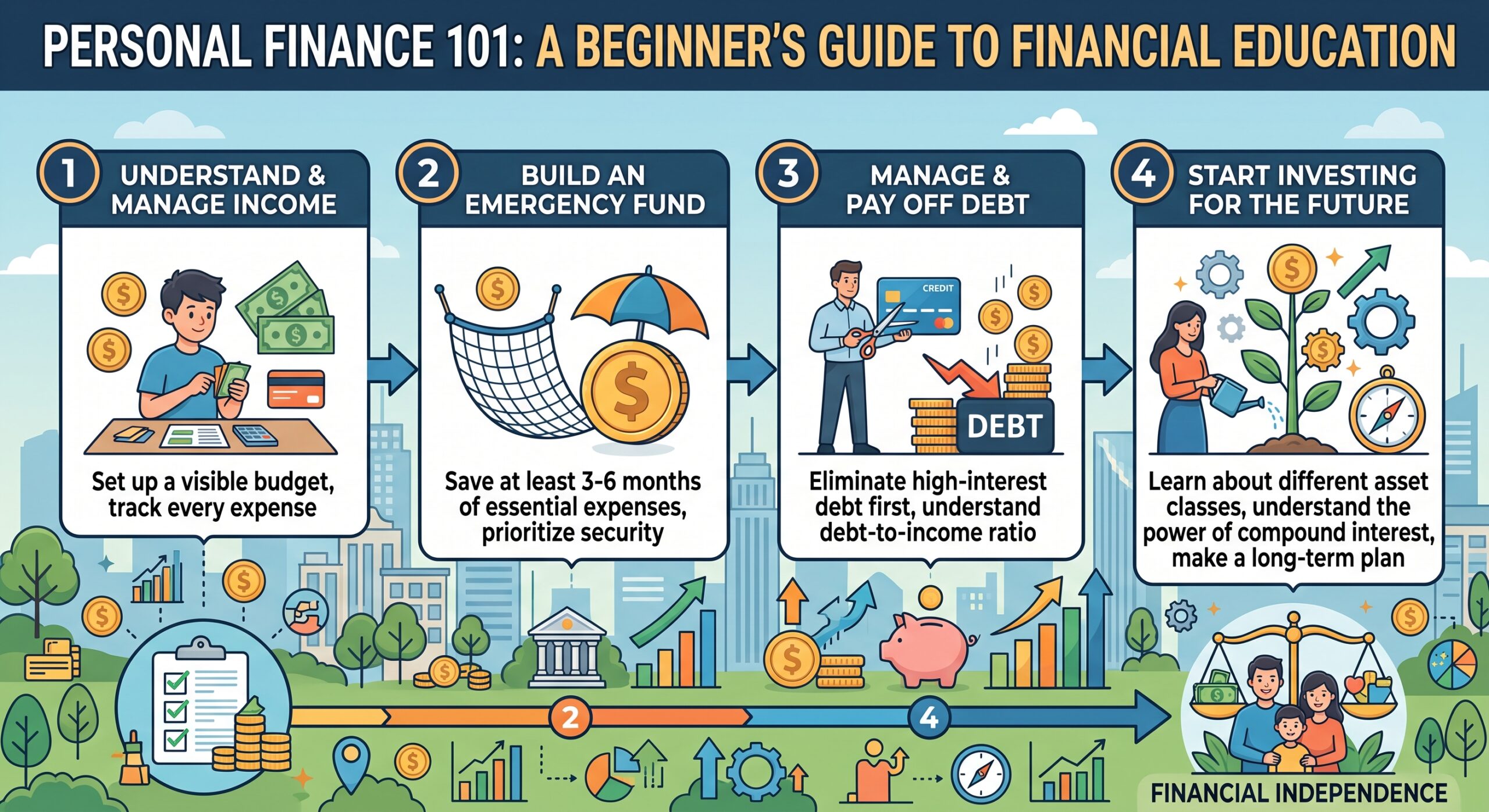
- Conduct a Cash Flow Audit: Track every dollar of income and expenditure over 30 days to identify spending patterns and baseline fixed costs.
- Establish a Realistic Budget: Use simple frameworks—like the 50/30/20 Rule (50% Needs, 30% Wants, 20% Savings/Debt Repayment)—to direct your money intentionally.
- Automate Savings: Set up automatic recurring transfers to savings and investment accounts right on payday to prioritize long-term goals.
- Utilize Reliable Educational Resources: Focus on verified, transparent educational resources from consumer protection bureaus, established institutions, and accredited professionals.
The Broader Impact of Financial Knowledge
Financial literacy does more than help individuals make sound choices—it creates a cascading positive effect across entire communities. Financially secure households reduce systemic economic vulnerabilities, lessen reliance on emergency social support systems, and invest more in education and local businesses.
By taking the time to understand personal finance fundamentals, individuals shift from passively reacting to economic changes to actively shaping their financial futures.
Disclaimer: This article is strictly for educational and informational purposes and should not be construed as individualized legal, tax, or financial advice. Readers should consult a licensed financial advisor or tax professional to tailor financial strategies to their specific circumstances.