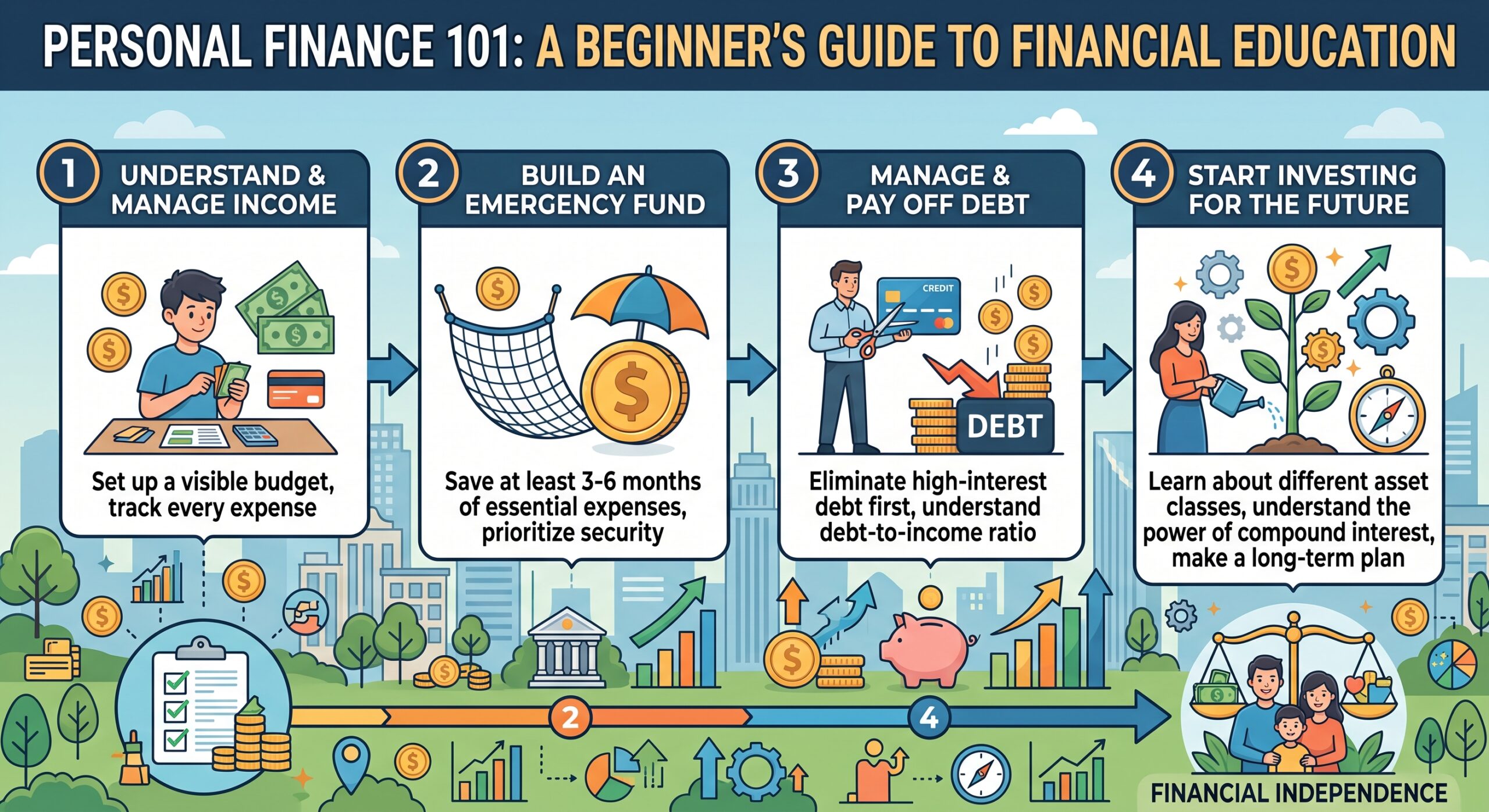
Financial literacy is one of the most critical life skills, yet it remains absent from most traditional school curricula. Navigating personal finances without foundational knowledge often leads to avoidable debt, stress, and missed opportunities for wealth accumulation. Achieving financial independence is rarely a matter of luck or earning a high income; rather, it stems from establishing sound money management habits early and maintaining them consistently over time.
1. Understanding Cash Flow: Income vs. Expenses
At its core, financial education begins with understanding cash flow—the movement of money into and out of your household. Cash flow dictates whether you are building wealth or accumulating liability.
- Gross vs. Net Income: Your gross income is what you earn on paper, while your net income (take-home pay) is what arrives in your bank account after taxes, benefits, and deductions. Always base your financial decisions on net income.
- Fixed Expenses: These are mandatory, recurring obligations with predictable amounts, such as rent or mortgage payments, utility baselines, insurance premiums, and minimum debt payments.
- Variable Expenses: These fluctuate month-to-month based on consumption and choices, including groceries, dining out, entertainment, gas, and shopping.
Tracking your cash flow for 30 to 90 days reveals spending leaks and provides a realistic baseline for setting future goals.
2. Mastering the Art of Budgeting
A budget is not a restrictive tool meant to eliminate enjoyment; it is a tactical blueprint that directs your money where to go instead of leaving you wondering where it went.
The 50/30/20 Framework
One of the most effective and adaptable budgeting frameworks is the 50/30/20 rule:
| Category | Recommended Allocation | Included Expenses |
| Needs | 50% of Net Income | Housing, essential groceries, utilities, basic transportation, minimum debt payments |
| Wants | 30% of Net Income | Dining out, hobbies, subscriptions, travel, non-essential shopping |
| Savings & Debt | 20% of Net Income | Emergency fund contributions, retirement accounts, extra debt payoff |
Zero-Based Budgeting
For individuals with variable income or specific payoff targets, Zero-Based Budgeting assigns every single earned dollar a job before the month begins (Income − Expenses − Savings = $0). This eliminates unallocated cash sitting passively in checking accounts where it is prone to impulse spending.
3. Establishing an Emergency Reserve
Unplanned financial disruptions—such as medical emergencies, sudden home repairs, or unexpected job loss—are inevitable. Without a dedicated financial cushion, these events force individuals to rely on high-interest credit cards or loans, initiating a cycle of debt.
- Target Reserve Size: Aim to accumulate 3 to 6 months’ worth of essential living expenses (covering “Needs” only).
- Storage Strategy: Keep your emergency fund liquid and separate from everyday checking accounts. A High-Yield Savings Account (HYSA) is optimal because it preserves capital, maintains immediate liquidity, and offsets inflation better than standard savings accounts.
4. Strategic Debt Management
Not all debt carries equal weight. Distinguishing between productive (“good”) debt and destructive (“bad”) debt is vital for long-term stability.
- Good Debt: Financing that leverages an asset expected to grow in value or increase future earning potential at low interest rates (e.g., reasonable student loans, a manageable primary mortgage).
- Bad Debt: High-interest consumer borrowing used to purchase depreciating assets or immediate consumables (e.g., credit card balances, buy-now-pay-later services, high-rate payday loans).
Proven Debt Payoff Strategies
If you carry high-interest debt, prioritize elimination using one of two structured frameworks:
- The Debt Avalanche: Pay minimum balances on all debts while directing every extra dollar toward the balance with the highest interest rate. This method minimizes the total interest paid over time, making it the most mathematically efficient approach.
- The Debt Snowball: Pay minimums on all obligations while directing extra funds toward the smallest balance, regardless of interest rate. Once the smallest debt is cleared, roll that payment amount into the next smallest. This method provides psychological momentum and quick wins.
5. The Fundamentals of Investing & Compound Growth
Saving money in cash is insufficient for long-term wealth building due to the erosive effect of inflation. Investing allows your capital to outpace inflation by buying productive assets.
The Power of Compound Interest
Compound interest occurs when earned returns are reinvested to generate their own returns. Over decades, compounding transforms modest, regular contributions into substantial wealth.
The future value of an investment compound can be expressed by the standard formula:
$$A = P \left(1 + \frac{r}{n}\right)^{nt}$$
Where:
- $A$ = Final amount accumulated
- $P$ = Principal balance (initial investment)
- $r$ = Annual interest rate (decimal)
- $n$ = Number of times interest compounds per year
- $t$ = Time in years
Because time ($t$) acts as an exponent, starting early—even with small sums—is far more advantageous than waiting to invest larger sums later in life.
Core Investment Vehicles
- Index Funds & ETFs: Low-cost, passive funds that track broad market indices (e.g., S&P 500 or MSCI World). They provide instant diversification across hundreds of companies, drastically reducing individual company risk.
- Tax-Advantaged Retirement Accounts: Vehicles such as employer-sponsored 401(k) plans or Individual Retirement Accounts (IRAs) offer tax benefits that accelerate wealth generation. Always contribute enough to secure any full employer match—this is effectively a 100% immediate return on your investment.
6. Protecting Your Financial Position
Building wealth is only half the equation; safeguarding it against unforeseen catastrophic events completes sound financial strategy.
- Health Insurance: Prevents medical bills from causing personal bankruptcy.
- Disability Insurance: Replaces a portion of your income if illness or injury leaves you unable to work.
- Term Life Insurance: Provides financial support to dependents in the event of premature death. Stick to straightforward term policy structures rather than complex whole-life products for most personal finance scenarios.
Final Principles for Long-Term Success
Financial literacy is not a static goal to achieve, but a continuous discipline. To maintain momentum:
- Automate Everything: Set up recurring transfers for savings, investments, and bill payments on payday to eliminate reliance on willpower.
- Avoid Lifestyle Inflation: Resist the urge to scale up spending proportionally whenever your earnings increase. Divert raises directly toward investments.
- Focus on Consistency: Small, consistent actions sustained over 20 to 30 years consistently outperform sporadic, radical financial overhauls.