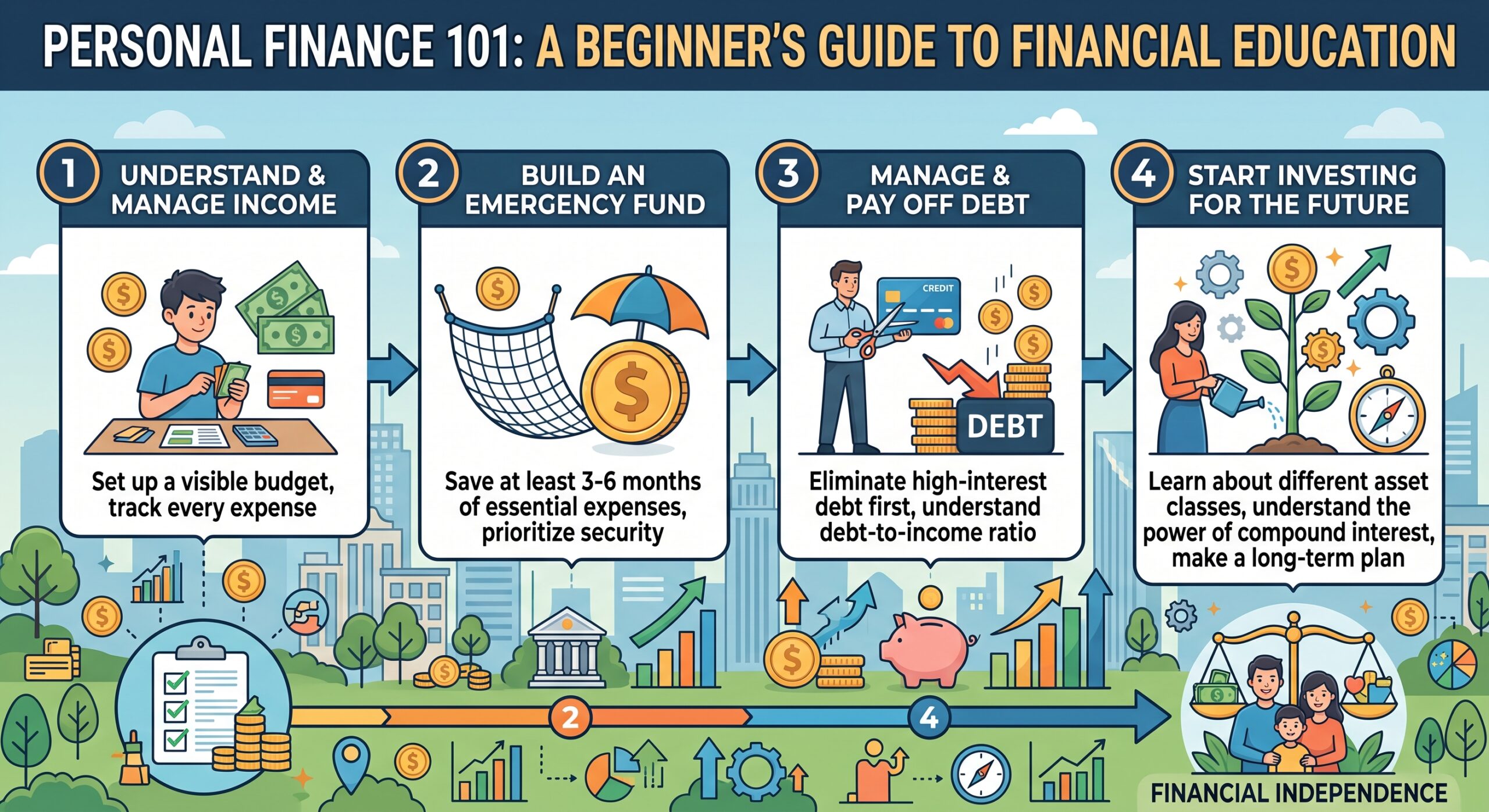

The concept of reliance on a single paycheck is increasingly becoming a financial vulnerability. Economic shifts, technological disruptions, and market volatility have highlighted the importance of diversification. Creating multiple sources of income through investing is no longer just a strategy for the wealthy; it is a fundamental pillar of modern financial stability and wealth building.
By transitioning from an active earner to an investor, you allow your capital to work for you. This approach creates streams of passive or semi-passive cash flow that can supplement your primary career, fund your lifestyle, or accelerate your journey toward financial independence.
Here is a comprehensive, step-by-step framework to building a resilient portfolio capable of generating reliable, recurring income.
1. The Core Philosophy: Shifting from Growth to Cash Flow
When most people think of investing, they focus on capital appreciation—buying an asset cheap and selling it later for a higher price. While growth is essential for accumulating initial wealth, creating sustainable income streams requires a shift toward income-generating assets.
The goal is to build a portfolio that distributes regular cash without requiring you to liquidate your underlying principal. This strategy leverages the power of compounding: instead of spending your investment returns immediately, you can reinvest them to buy more income-producing assets, exponentially growing your cash flow over time.
2. High-Yield Dividend Stocks: Owning a Piece of Corporate Profits
One of the most accessible ways to start generating investment income is through dividend investing. When you purchase shares of a dividend-paying company, you receive a portion of the company’s earnings, typically distributed every quarter.
Dividend Aristocrats vs. High-Yield Traps
When selecting individual stocks, it is easy to fall into the trap of chasing the highest yield. However, an exceptionally high dividend yield (e.g., above 8% or 10%) can sometimes indicate a company in financial distress whose stock price has plummeted.
Instead, focus on Dividend Aristocrats or Dividend Kings—companies listed on the S&P 500 that have not only paid but actively increased their dividend payouts for at least 25 and 50 consecutive years, respectively. These businesses generally possess robust balance sheets, durable competitive advantages, and predictable cash flows.
3. Fixed-Income Securities: The Bedrock of Stability
For consistent and predictable cash flow, fixed-income investments are indispensable. These instruments act as loans you provide to governments or corporations in exchange for regular interest payments (coupons) and the return of your principal upon maturity.
- Government Bonds and Treasury Securities: Backed by the full faith and credit of governments, these are considered among the safest investments globally. They provide steady, predictable interest payments, making them an excellent tool for capital preservation.
- Corporate Bonds: Issued by companies to fund operations or expansion. They generally offer higher yields than government bonds to compensate for the higher risk of corporate default.
- Certificates of Deposit (CDs) and High-Yield Savings Accounts (HYSAs): While technically banking products rather than capital market investments, modern HYSAs and fixed-term CDs offer competitive, low-risk yields that serve as a great parking space for your emergency fund or short-term investment capital.
4. Real Estate Investment Trusts (REITs): Liquid Property Income
Real estate is a classic income generator, but managing physical property requires significant capital, time, and effort. Real Estate Investment Trusts (REITs) eliminate these barriers.
REITs are companies that own, operate, or finance income-producing real estate across various sectors, such as residential apartments, commercial office buildings, retail centers, or healthcare facilities.
The REIT Advantage: By law, REITs must distribute at least 90% of their taxable income to shareholders in the form of dividends.
Because REITs trade on major stock exchanges just like standard stocks, they provide investors with institutional-grade real estate exposure, high dividend yields, and the liquidity to buy or sell shares instantly.
5. Exchange-Traded Funds (ETFs): Diversification Made Simple
For individuals who prefer a hands-off approach, Exchange-Traded Funds (ETFs) offer a way to gain exposure to hundreds of income-producing assets through a single investment.
Instead of researching individual stocks or bonds, you can utilize specialized income ETFs:
- Dividend ETFs: Track indexes of high-performing, dividend-paying companies (e.g., funds tracking the Vanguard Dividend Appreciation index).
- Bond ETFs: Provide a diversified basket of government, corporate, or municipal bonds with varying maturities, distributing interest monthly.
- Multi-Asset Income ETFs: Diversify across dividend stocks, bonds, REITs, and preferred shares to maximize yield while mitigating the volatility of any single asset class.
6. Peer-to-Peer (P2P) Lending and Private Debt
The digital age has democratized debt investing through Peer-to-Peer (P2P) platforms. By using these platforms, you can act as the bank, lending money directly to individuals or small businesses.
In return, borrowers pay back the principal along with interest, which becomes your income stream. While private debt offers higher yield potential than traditional fixed-income securities, it carries a higher risk of borrower default. Diversifying your capital across hundreds of small loan fragments (notes) is crucial to mitigating this risk.
Strategies for Portfolio Construction and Risk Management
Creating multiple streams of income is only effective if those streams are resilient during economic downturns. To build a robust income portfolio, implement these core risk-management practices:
Asset Allocation and Diversification
Avoid concentration risk by spreading your capital across different asset classes, industries, and geographic regions. If a specific sector faces a downturn, your income from other sectors can keep your cash flow stable.
Tax Optimization
Investment income is subject to taxation, and the rate often depends on the asset type and your holding period. Utilize tax-advantaged accounts (such as IRAs or 401ks in the U.S., or equivalent tax-sheltered accounts in your region) to shield your dividend and interest payments from immediate taxation, allowing your wealth to compound faster.
Balancing Yield and Growth
A pure income portfolio can sometimes fall victim to inflation if the underlying capital doesn’t grow. A balanced strategy allocates a portion of the portfolio to dividend-growth equities, ensuring that your income streams increase over time to preserve your purchasing power.
Summary of Income Investment Streams
| Asset Class | Primary Income Mechanism | Risk Level | Liquidity |
| Dividend Stocks | Quarterly Dividend Distributions | Moderate to High | High |
| Bonds / Treasuries | Semi-Annual Coupon Payments | Low to Moderate | High |
| REITs | High-Yield Monthly/Quarterly Dividends | Moderate | High |
| Income ETFs | Aggregated Dividends and Interest | Moderate | High |
| P2P Lending | Monthly Principal and Interest Payments | High | Low |
Conclusion: Start Small and Reinvest
Building multiple sources of income through investing is a journey that requires patience, discipline, and consistent execution. You do not need a massive amount of capital to begin. By starting with fractional shares, low-cost ETFs, or high-yield savings instruments, you can establish your first investment income streams today.
The secret to long-term success lies in the consistency of your contributions and the deliberate reinvestment of your earnings. Over time, these individual streams of income will coalesce into a powerful financial engine, offering you enhanced security, flexibility, and ultimate control over your financial future.