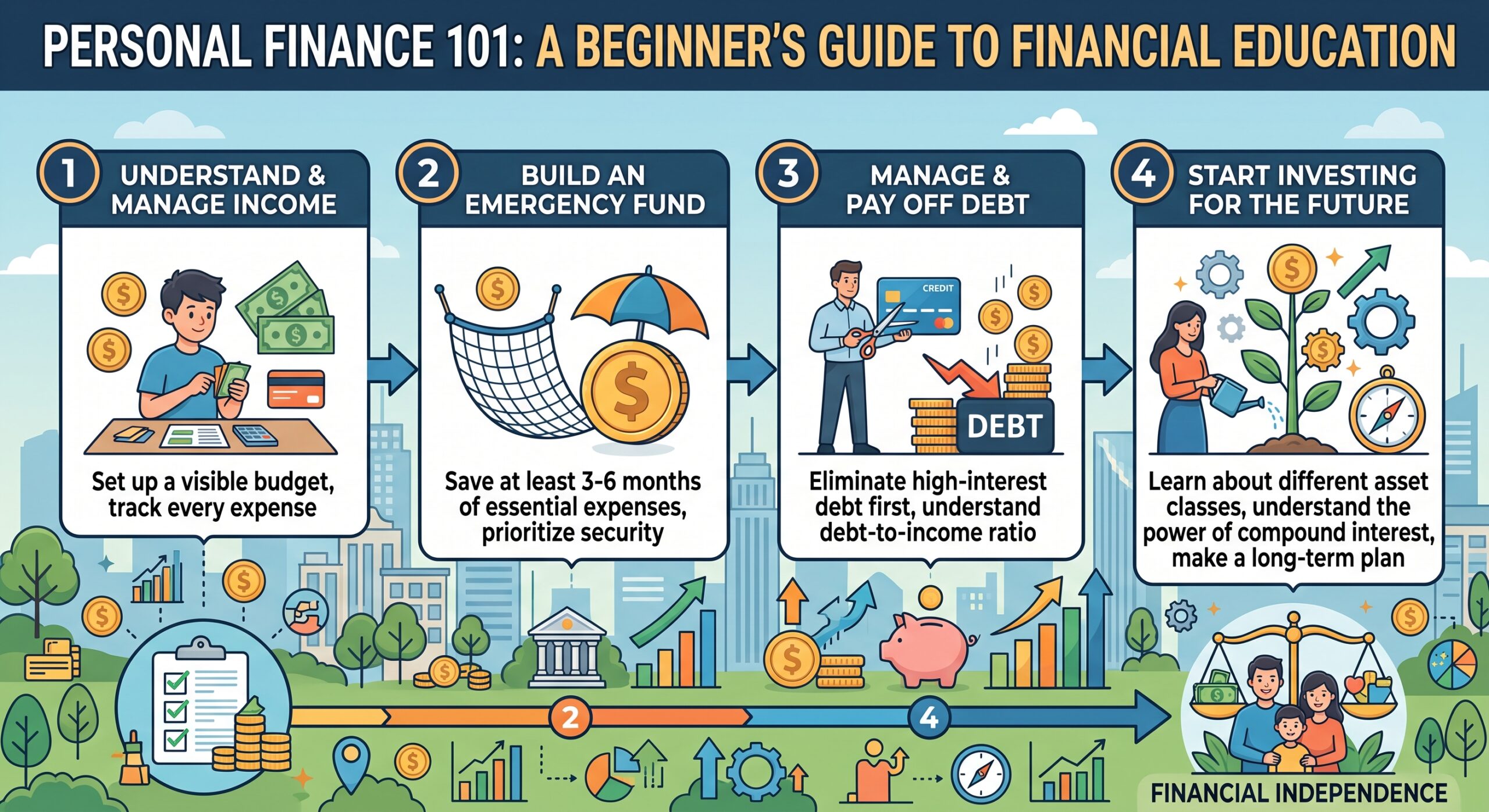

The journey toward financial independence often feels like navigating a vast, uncharted ocean. For many, the word “investment” conjures images of chaotic trading floors or complex mathematical equations. However, at its core, investing is simply the act of putting your money to work today so that it can provide you with more money in the future.
This guide is designed to demystify the world of finance and provide a clear, actionable roadmap for beginners looking to foster sustainable financial growth.
1. The Mindset: Shifting from Saving to Investing
Before looking at tickers and charts, it is essential to understand the difference between saving and investing.
- Saving is setting money aside in a safe, liquid place (like a savings account) for short-term goals or emergencies. While safe, the purchasing power of savings can be eroded over time by inflation.
- Investing involves purchasing assets—such as stocks, bonds, or real estate—with the expectation that they will generate income or increase in value over time.
The “secret sauce” of investing is Compound Interest. Often described as the eighth wonder of the world, compound interest is the process where your investment’s earnings are reinvested to generate their own earnings. Over decades, this creates an exponential growth curve that can turn modest contributions into significant wealth.
2. Building the Foundation: Prerequisites for Investing
You wouldn’t build a house on sand, and you shouldn’t start investing without a solid financial base. Before committing capital to the markets, ensure you have checked these three boxes:
High-Interest Debt Elimination
If you have credit card debt with an interest rate of 20%, any investment returning 10% is technically a net loss. Prioritize paying off high-interest liabilities first.
The Emergency Fund
Life is unpredictable. Aim to save three to six months of living expenses in a high-yield savings account. This “buffer” ensures that if your car breaks down or you lose your job, you won’t be forced to sell your investments at a loss during a market downturn.
Defined Goals and Timeline
Are you investing for a house down payment in five years or for retirement in thirty? Your time horizon dictates your risk tolerance. Generally, the longer your timeline, the more risk you can afford to take.
3. Understanding Asset Classes
Assets are the vehicles that carry you toward your financial goals. The most common classes for beginners include:
Stocks (Equities)
When you buy a stock, you are buying a piece of a company. If the company grows and profits, the stock price usually rises. Stocks offer the highest potential for growth but come with higher volatility.
Bonds (Fixed Income)
A bond is essentially a loan you provide to a government or corporation. In return, they pay you interest over a set period and return your principal at the end. Bonds are generally more stable than stocks and provide a predictable income stream.
Real Estate
This involves owning physical property or investing in REITs (Real Estate Investment Trusts), which allow you to invest in large-scale properties without having to manage them personally.
4. The Power of Diversification and ETFs
One of the most common mistakes beginners make is “putting all their eggs in one basket.” If you invest all your money into a single tech company and that company fails, your portfolio crashes.
Diversification is the practice of spreading your investments across various assets and sectors to reduce risk. The easiest way for a beginner to achieve this is through Index Funds or Exchange-Traded Funds (ETFs).
An S&P 500 ETF, for instance, allows you to own a small slice of the 500 largest companies in the United States simultaneously. If one company underperforms, the others can balance the scales. This passive approach is often more effective and cheaper than trying to “pick winners.”
5. Risk vs. Reward: Finding Your Balance
In the financial world, risk and reward are inextricably linked.
- Low Risk: Savings accounts, Treasury bonds. (Low potential return).
- Moderate Risk: Balanced ETFs, blue-chip stocks. (Moderate potential return).
- High Risk: Individual small-cap stocks, cryptocurrencies. (High potential return).
Understanding your Risk Tolerance—how much market fluctuation you can stomach without panicking—is vital. A common strategy for beginners is Asset Allocation, where you mix different asset classes based on your age and goals. A classic (though now flexible) rule of thumb is subtracting your age from 100 to determine what percentage of your portfolio should be in stocks.
6. Investment Strategies for Long-Term Growth
Success in investing is rarely about “timing the market”; it’s about “time in the market.” Here are two essential strategies:
Dollar-Cost Averaging (DCA)
Instead of waiting for the “perfect moment” to invest a large sum, you invest a fixed amount of money at regular intervals (e.g., $200 every month), regardless of the price. When prices are high, you buy fewer shares; when prices are low, you buy more. This reduces the impact of volatility.
Rebalancing
Over time, some investments will grow faster than others, changing your original asset allocation. Rebalancing involves selling a bit of what has grown and buying more of what has lagged to return to your target mix.
7. Modern Tools and Security
In the digital age, starting is easier than ever. Robo-advisors and discount brokerage apps have lowered the barrier to entry. However, with digital convenience comes the need for vigilance.
- Security First: Use strong, unique passwords and enable Two-Factor Authentication (2FA) on all financial accounts.
- Beware of Scams: If an investment promises “guaranteed” high returns with “zero risk,” it is likely a scam or a Ponzi scheme.
- Stay Informed: Cybersecurity is a part of financial health. Protect your digital identity as fiercely as you protect your capital.
8. Common Pitfalls to Avoid
- Emotional Investing: Selling when the market drops (panic selling) or buying because of “Fear of Missing Out” (FOMO).
- Ignoring Fees: High management fees can eat away a massive portion of your returns over 30 years. Look for low-cost funds.
- Lack of Patience: Wealth building is a marathon. Avoid “get-rich-quick” schemes that lead to permanent capital loss.
Conclusion
Financial growth is not a matter of luck; it is a matter of discipline and consistency. By starting early, diversifying your assets, and maintaining a long-term perspective, you can harness the power of the global economy to build a secure future.
The best time to start was ten years ago; the second best time is today. Begin with what you have, keep learning, and stay the course.
Disclaimer: This article is for informational purposes only and does not constitute financial, legal, or tax advice. Always consult with a qualified professional before making significant investment decisions.