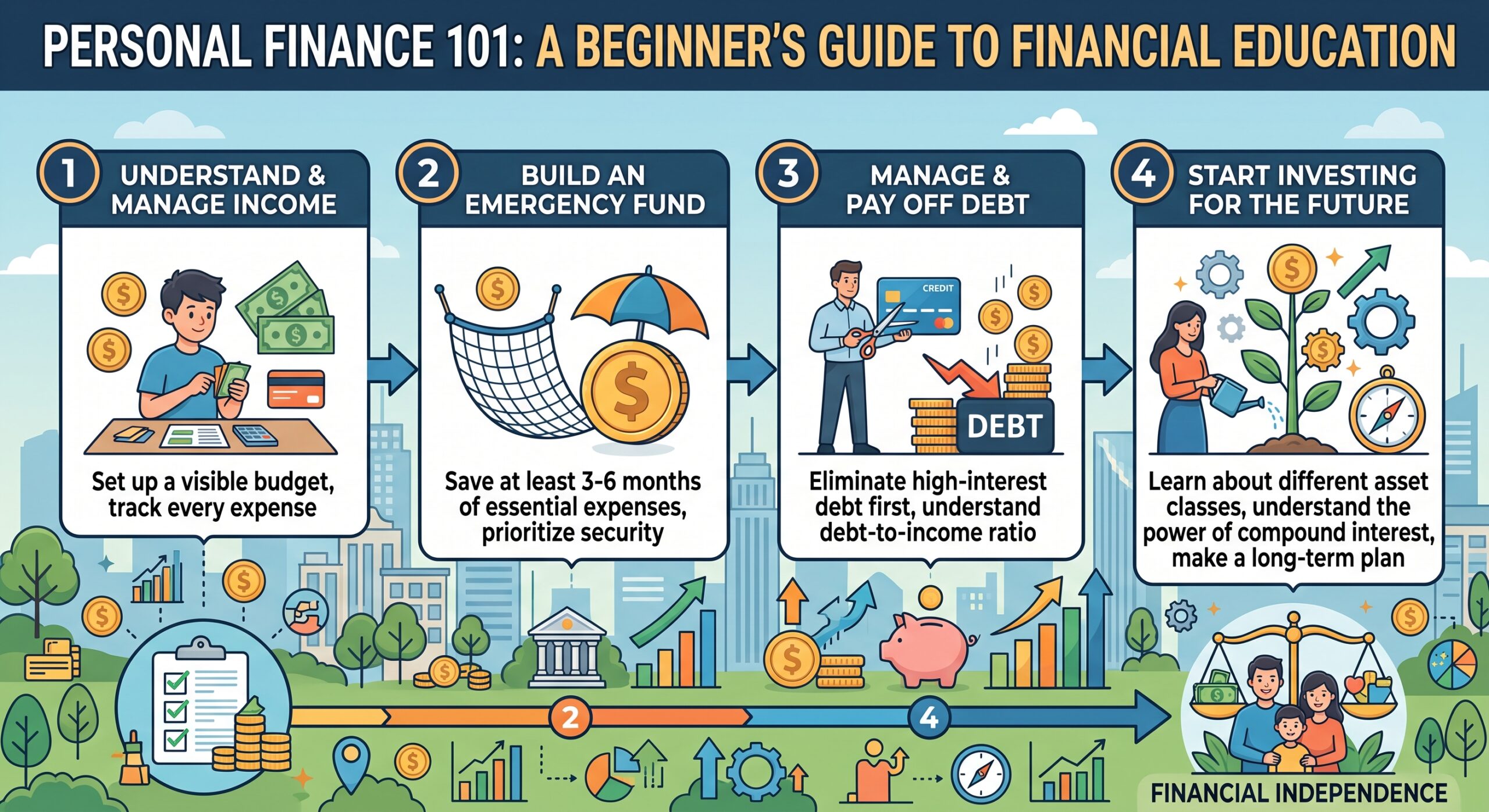

Financial security is rarely the result of a single lucky break or an overnight windfall. Instead, it is built brick by brick through a deliberate balance of two main engines: income generation and strategic investing.
While earning a dependable income provides the fuel for your financial plan, investing acts as the engine that transforms today’s earnings into long-term independence. Understanding how these two forces interact is the single most effective way to build lasting resilience against economic shifts, unexpected emergencies, and life transitions.
What Financial Security Actually Means
Before diving into tactics, it helps to establish a clear definition. Financial security is not necessarily about having millions in the bank; rather, it is the state of having enough income, liquid savings, and invested assets to comfortably cover your living expenses, handle unexpected disruptions, and work toward long-term goals without constant financial stress.
True security typically moves through three distinct phases:
- Stability: Covering basic monthly obligations consistently while eliminating high-cost debt.
- Flexibility: Having a dedicated emergency buffer and multiple income channels to absorb career or economic shocks.
- Independence: Accumulating an investment portfolio capable of generating enough income or returns to sustain your desired lifestyle permanently.
Pillar 1: Optimizing and Diversifying Income
Income is the baseline engine of your financial system. Without surplus income, even the best investment strategy remains theoretical. To build financial security, you must focus on both maximizing your core earnings and expanding into additional income streams.
Maximizing Active Earned Income
Your primary career or business is usually your greatest cash-flow engine early on. Increasing your primary income accelerates your ability to save and invest. Key strategies include:
- Targeted Skill Acquisition: Focus on acquiring high-value skills—such as advanced data analysis, strategic leadership, or specialized technical certifications—that directly correlate with higher compensation.
- Value-Based Positioning: Negotiate compensation based on measurable outcomes and revenue impact rather than time spent or task volume.
- Career Trajectory Planning: Regularly evaluate whether your current industry or employer offers clear upside potential and upward mobility.
Developing Secondary Income Streams
Relying entirely on a single employer or client creates vulnerability. Diversifying your income reduces systemic risk:
- Freelance or Consulting Work: Monetize expertise honed in your primary career to serve independent clients.
- Digital or Scalable Products: Develop assets—such as educational courses, software tools, or specialized templates—that can be created once and sold repeatedly.
- Micro-Businesses: Launch a lean side venture with low initial overhead to test products or services in growing markets.
Pillar 2: Building the Foundation (Risk Mitigation)
Investing without a solid financial base is like building a house on soft soil. Before directing funds into volatile market assets, ensure your financial foundation is protected against downside risks.
Establish a Liquidity Cushion
An emergency fund is your first line of defense against life’s unpredictable moments, such as unexpected medical costs, car repairs, or temporary job loss.
- Maintain 3 to 6 months’ worth of essential expenses in a high-yield savings account or short-term liquid instrument.
- Keep these funds separate from your daily checking account to prevent accidental spending.
Eliminate High-Interest Debt
High-interest debt—particularly credit card balances and high-rate personal loans—acts as a direct drag on your wealth creation. Paying off a credit card with a 20% annual percentage rate (APR) yields a guaranteed 20% return on your money, a performance benchmark that market investments cannot match reliably over short horizons.
Pillar 3: Investing for Long-Term Wealth
Once your foundation is secure and cash flow is positive, the next imperative is to put surplus capital to work. Investing allows your money to outpace inflation and leverage the power of compound returns over time.
The Power of Asset Allocation
Asset allocation refers to how you divide your portfolio among core categories: equities (stocks), fixed income (bonds), and real assets (such as real estate).
| Asset Class | Primary Role | Risk Level |
| Equities / Index Funds | Long-term capital growth and inflation protection | Moderate to High |
| Fixed Income / Bonds | Capital preservation and portfolio stabilization | Low to Moderate |
| Real Estate | Rental income generation and potential equity growth | Moderate |
| Cash Equivalents | Immediate liquidity and capital safety | Very Low |
The Core-and-Explore Strategy
A proven structure for balanced growth involves dividing your portfolio into two segments:
- Core Portfolio (70%–80%): Low-cost, broadly diversified broad-market index funds or ETFs. This core tracks overall economic expansion, minimizes individual company risk, and keeps expense ratios extremely low.
- Explore Portfolio (20%–30%): Higher-conviction individual equities, thematic ETFs, or alternative investments that offer the potential for above-average growth, aligned with your personal risk tolerance.
The Mechanics of Compounding
Time in the market consistently beats trying to time the market. Through compound returns, the gains earned on your investments begin earning their own returns. Automating monthly contributions through dollar-cost averaging (investing a fixed amount regularly regardless of market ups and downs) ensures consistency and eliminates emotional decision-making during market swings.
Pillar 4: Protecting Your Security
Achieving financial security requires equal attention to wealth creation and wealth preservation.
- Insurance Coverage: Maintain adequate health, disability, property, and life insurance. A single uninsured crisis can erase years of disciplined saving.
- Tax Efficiency: Utilize tax-advantaged retirement accounts available in your jurisdiction (such as IRAs, 401(k)s, ISAs, or equivalent employer-sponsored plans) to shield growth and income from immediate taxation.
- Inflation Protection: Avoid holding excessive cash over long periods. Holding assets that appreciate alongside inflation—such as real estate and diversified equities—is critical to maintaining your purchasing power.
Conclusion: Taking Systematic Action
Financial security is not a single milestone, but a continuous management process. Start by evaluating where you stand today: secure a clear view of your monthly cash flow, build your emergency reserve, systematically pay down high-interest obligations, and establish an automated investment routine.
By pairing a growing, diversified income with a disciplined, long-term investment strategy, you build a resilient financial framework capable of supporting your goals across every stage of life.
> Disclaimer: This article is for educational and informational purposes only and does not constitute formal financial or investment advice. Always consult with a qualified financial advisor before making significant financial decisions.