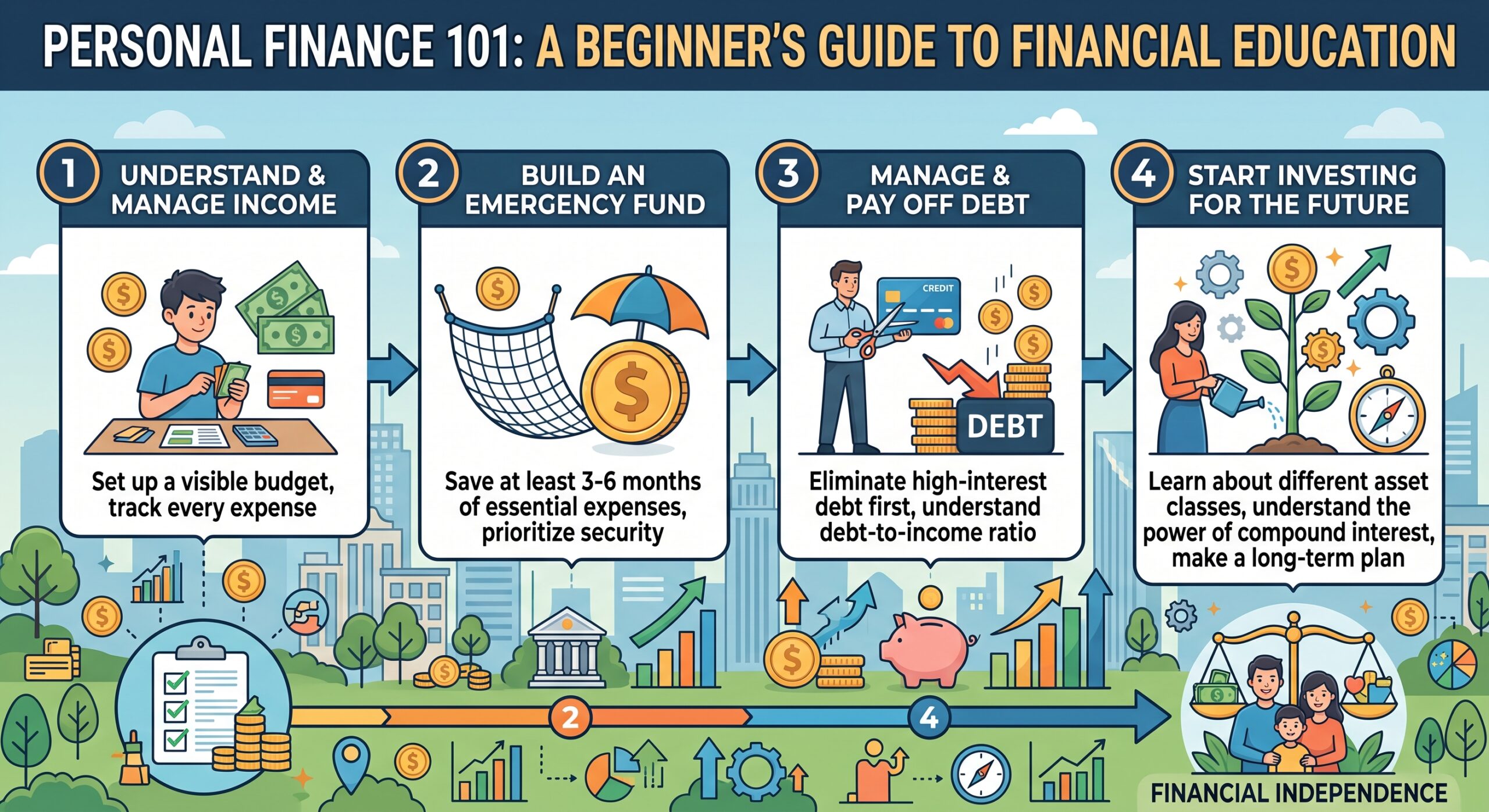

For many, the barrier to entering the financial markets isn’t a lack of interest, but the misconception that investing requires a massive upfront fortune. The reality of modern finance is fundamentally different. Thanks to fractional shares, digital platforms, and shifting macroeconomic landscapes, the size of your initial capital is far less critical than the strategy, discipline, and timeline you deploy.
Turning small, consistent investments into substantial long-term wealth is a proven mathematical reality. However, achieving significant returns from modest beginnings requires moving past speculative hype and anchoring your approach in sound financial theory and disciplined execution.
1. The Core Engine: Exponential Growth via Compounding
The most powerful tool available to a small-scale investor is time, powered by the mathematical phenomenon of compound interest. Compounding occurs when the earnings generated by an investment are reinvested to generate their own earnings. Over short horizons, the effect appears negligible; over decades, it becomes exponential.
Consider the basic formula for compound interest:
Where:
- $A$ is the final amount of wealth accumulated.
- $P$ is the principal investment (initial capital).
- $r$ is the annual nominal interest rate.
- $n$ is the compounding frequency per year.
- $t$ is the time in years.
If you start with a principal ($P$) of just $100 and contribute $100 monthly at an average annual return ($r$) of 8%, compounding monthly ($n=12$), your portfolio will grow significantly over time ($t$). In 10 years, you will have roughly $18,500. In 30 years, that modest monthly habit transforms into over $150,000. The takeaway is clear: consistency and time trump a large starting balance.
2. Strategic Asset Allocation for Small Portfolios
To maximize the growth potential of a small portfolio while mitigating catastrophic risk, investors must understand asset allocation. High returns are inherently tied to risk, but strategic diversification allows you to optimize your risk-adjusted returns.
Broad-Market Index Funds and ETFs
For individuals starting small, picking individual stocks introduces excessive unsystematic risk—the risk unique to a single company. Exchange-Traded Funds (ETFs) and index funds that track broad markets (such as the S&P 500 or the MSCI World Index) allow an investor to buy a tiny slice of hundreds of companies simultaneously with a single transaction. This provides instant diversification, protecting your capital from the failure of any single corporation.
Micro-Investing and Fractional Shares
Historically, if a single share of a high-performing tech company cost $400, a small-scale investor was locked out. Today, brokerage platforms allow the purchase of fractional shares. This means you can invest as little as $5 or $10 into premium equities, ensuring your capital is fully utilized rather than sitting idly in cash.
3. Mitigating Volatility: Dollar-Cost Averaging (DCA)
Market timing is a notoriously unreliable strategy, even for institutional asset managers. For small investors, trying to buy at the absolute bottom and sell at the top often leads to emotional decision-making and capital depletion.
The antidote to market volatility is Dollar-Cost Averaging (DCA). With DCA, you invest a fixed dollar amount at regular intervals (e.g., every month or every paycheck), regardless of whether the market is up or down.
| Market Condition | Stock Price | Your Fixed Investment | Shares Purchased |
| High | $50 | $100 | 2.0 |
| DIP / Bear Market | $25 | $100 | 4.0 |
| Recovery | $40 | $100 | 2.5 |
As illustrated above, when prices are high, your fixed dollar amount naturally buys fewer shares. When prices drop during a market downturn, your fixed amount automatically purchases more shares. Over the long term, this strategy lowers your average cost per share and eliminates the emotional anxiety of market timing.
4. Balancing Asymmetrical Risk and Security
While broad-market ETFs form the stable foundation of a growth portfolio, turning small sums into truly large returns sometimes involves allocating a disciplined, minor portion of capital toward higher-growth, higher-risk opportunities. This is known as seeking asymmetrical risk-reward profiles—where the potential downside is limited to your small investment, but the potential upside is multiples of that amount.
Corporate Governance and Growth Stocks
Investing in small-cap or mid-cap companies with robust corporate governance, low debt-to-equity ratios, and strong competitive advantages (economic moats) can yield above-average returns. Look for sectors experiencing secular macroeconomic tailwinds, such as cybersecurity, automated infrastructure, or green energy transitions.
The Regulatory and Security Guardrails
When seeking higher returns, vigilance regarding cybersecurity and platform safety is paramount. High-yield opportunities frequently attract bad actors and fraudulent schemes. High-quality investing requires utilizing brokerages regulated by major financial authorities (such as the SEC or FCA), enabling two-factor authentication (2FA), and thoroughly auditing the financial disclosures of any entity before deploying capital.
5. Behavioral Finance: The Hidden Barrier to Large Returns
The math of turning small investments into large returns is straightforward; the psychology is the difficult part. Behavioral finance shows that human beings are prone to loss aversion, often selling their investments in a panic during normal market corrections, effectively locking in losses.
To protect your portfolio from your own impulses, consider these institutional-grade habits:
- Automate the Process: Set your monthly investment to automatically deduct from your income. If you never see the cash in your spending account, you won’t miss it.
- Ignore the Daily Noise: Avoid checking portfolio balances daily. Short-term market fluctuations are noise; long-term economic expansion is the signal.
- Maintain an Emergency Fund: Never invest money needed for immediate living expenses. Having a separate liquidity buffer ensures you won’t be forced to liquidate your investments at a loss during a market downturn.
Conclusion: The Blueprint for Success
Turning small investments into massive returns is not a function of luck, insider tips, or volatile speculation. It is an intentional, structured process built on the foundations of compounding, strict diversification via broad-market vehicles, and the emotional discipline of dollar-cost averaging.
By starting immediately—even with a nominal amount—and continually reinvesting your distributions, you leverage macroeconomic growth to systematically build long-term financial freedom. The best time to start building wealth was a decade ago; the second best time is today.