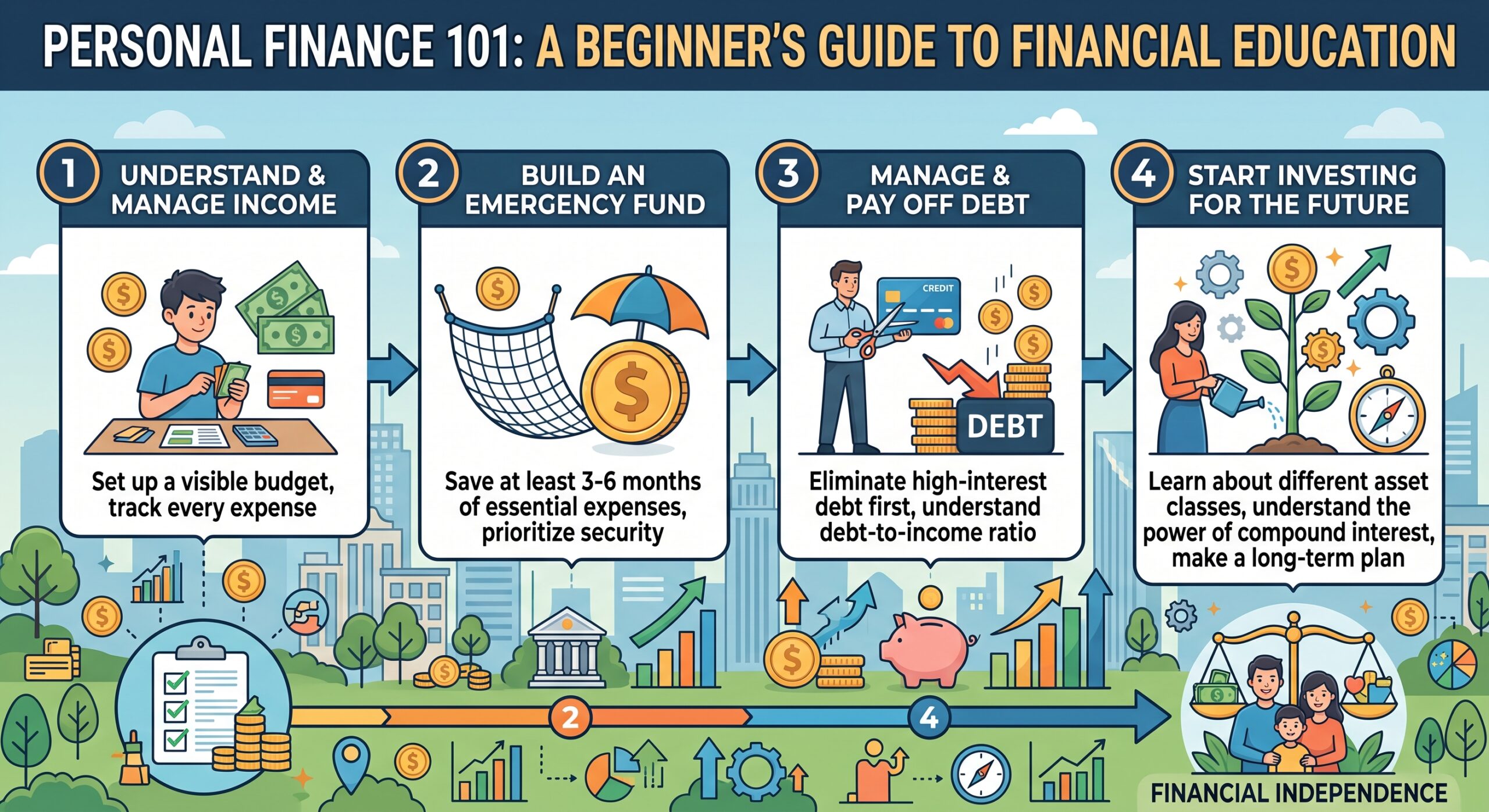

The concept of financial freedom has evolved from a distant, retirement-age dream into an active, lifestyle-oriented pursuit for millions worldwide. No longer just about accumulating a specific number of zeros in a bank account, true financial freedom represents the ability to make life decisions without being constrained by financial stress or the necessity of a traditional nine-to-five job.
However, achieving this state of autonomy is rarely an accident. It is the result of a deliberate, structured relationship between a person’s capital and the global markets. At the core of this journey lies a fundamental truth: earned income creates stability, but invested capital creates freedom.
Understanding how investments transform into the engine of financial independence is the first and most critical step toward breaking the cycle of living paycheck to paycheck.
Defining the Core Concepts
To understand the synergy between these two ideas, we must first define what they truly mean in a modern economic context.
Financial Freedom: More Than Wealth
Financial freedom is often misunderstood as being “rich.” While wealth is a component, freedom is qualitative rather than quantitative. It is defined by control over your time.
There are generally three stages to this financial evolution:
- Financial Security: Having enough savings and income to cover basic living expenses (housing, food, healthcare) without immediate panic if you lose your job.
- Financial Independence: Having accumulated assets that generate enough passive income to cover your current lifestyle indefinitely.
- Financial Freedom: The ultimate stage, where your passive income comfortably covers your dream lifestyle, allowing for abundance, philanthropy, and spontaneous life choices.
Investments: The Engine of Growth
Investments are vehicles into which you put money with the expectation that it will grow over time, generating income, capital gains, or both. Unlike a traditional savings account—which often loses purchasing power to inflation—investments actively put your money to work in the economy through equities, real estate, bonds, or businesses.
The Catalyst: Why Savings Alone Will Fail
A common misconception is that financial freedom can be achieved simply by working hard and saving diligently. While discipline is commendable, reliance entirely on fiat currency savings is a mathematically flawed strategy for long-term wealth.
The silent assassin of uninvested wealth is inflation. If the average inflation rate hovers around 2% to 3% per year, the purchasing power of cash sitting in a standard bank account is effectively cut in half every 24 to 36 years.
The Inflation Impact: If you save $100,000 today and hide it under a mattress, that money will still look like $100,000 in twenty years, but it will only buy what $60,000 buys today.
Investments act as a financial shield and an accelerator. By placing capital into assets that historically outpace inflation—such as the stock market or real estate—you protect your purchasing power and ensure that your hard-earned money retains its real-world value.
How Investments Foster Financial Freedom
The transition from working for money to having your money work for you relies on several mathematical and psychological mechanisms.
1. The Magic of Compounding Interest
Albert Einstein famously called compound interest the “eighth wonder of the world.” In the context of investing, compounding occurs when the earnings on your investment begin to earn their own earnings.
In the initial years, the growth seems slow and linear. However, over a decade or two, the curve becomes exponential.
[ Initial Investment ] ➔ [ Earnings ] ➔ [ Reinvested Earnings ] ➔ [ Exponential Growth ]
For example, investing $500 a month at an average annual return of 8% yields roughly $300,000 after 20 years. However, if left for 30 years, that amount balloons to over $700,000. The majority of that final sum is not the money you physically contributed; it is the compound growth. This exponential curve is the exact vehicle that bridges the gap between a modest salary and financial self-sufficiency.
2. Transitioning from Active to Passive Income
The traditional economic model relies on a linear transaction: Time = Money. The fundamental limitation here is that time is a finite resource; you only have 24 hours in a day.
Investing breaks this linear constraint by introducing passive income.
| Asset Type | How It Generates Passive Income |
| Dividend Stocks | Regular cash payouts distributed by profitable corporations to their shareholders. |
| Real Estate | Monthly rental income paid by tenants, which often increases over time with inflation. |
| Fixed Income (Bonds) | Periodic interest payments (coupons) returned by governments or corporations for lending them capital. |
| Index Funds/ETFs | Automatic capital appreciation that can be systematically liquidated using rules like the “4% Rule.” |
When the collective passive income from these investment vehicles equals or exceeds your monthly living expenses, you have officially reached financial independence. The requirement to sell your time for survival is permanently eliminated.
Designing an Investment Strategy for Autonomy
Achieving financial freedom through investing requires a strategic framework. It is not about gambling on volatile meme stocks or chasing “get-rich-quick” schemes; it is about calculated risk management and consistency.
asset Allocation and Diversification
The bedrock of a resilient investment portfolio is diversification. By spreading capital across different asset classes (equities, bonds, real estate, commodities), you ensure that a downturn in one sector does not wipe out your financial foundation. A younger investor aiming for rapid growth might lean heavier into equities, while someone closer to their financial freedom target may increase exposure to income-generating bonds for stability.
Dollar-Cost Averaging (DCA)
Trying to time the market is a losing game for most retail investors. Instead, successful wealth builders use Dollar-Cost Averaging—investing a fixed amount of money at regular intervals (e.g., monthly), regardless of market conditions. This removes emotion from the equation, ensuring you buy more shares when prices are low and fewer when prices are high.
The Psychological Shift: Mindset and Discipline
The technical mechanics of investing are relatively straightforward. The true challenge of the relationship between investments and financial freedom is psychological.
To successfully build an investment portfolio that grants freedom, an individual must transition from a consumer mindset to an owner mindset.
- The Consumer: Views money as a tool to acquire immediate goods, services, and social status.
- The Owner: Views money as seed capital. Every dollar invested is a “financial soldier” sent out to work, bring back more dollars, and secure future liberty.
Delayed gratification is the ultimate price of admission for financial freedom. Choosing to invest $5,000 today instead of spending it on a luxury vacation requires prioritizing future peace of mind over temporary, present-day luxury.
Conclusion: The Ultimate Return on Investment
Ultimately, the relationship between investments and financial freedom is deeply symbiotic. Financial freedom is the destination, and investing is the vehicle that gets you there.
By systematically converting earned income into cash-flowing, appreciating assets, you slowly de-risk your life from economic downturns, corporate restructuring, and the exhaustion of the daily grind.
The greatest asset wealth buys is not a supercar, a mansion, or luxury goods. The ultimate return on investment is the ability to wake up in the morning and decide exactly how you want to spend your day. By understanding, respecting, and leveraging the power of investments, financial freedom ceases to be a utopian dream and becomes an inevitable reality.