
Entering the professional world is an exciting milestone. For many, a first career-track job brings the novelty of a steady income—and the immediate question of what to do with it. While it is tempting to upgrade your lifestyle immediately, the financial decisions you make in your twenties and thirties will heavily dictate your long-term financial freedom.
In today’s macroeconomic landscape, young professionals have unique opportunities. Navigating this terrain requires balancing immediate income generation with consistent, automated investing. Here is a comprehensive guide to building a resilient financial foundation, maximizing your income, and putting your money to work early.
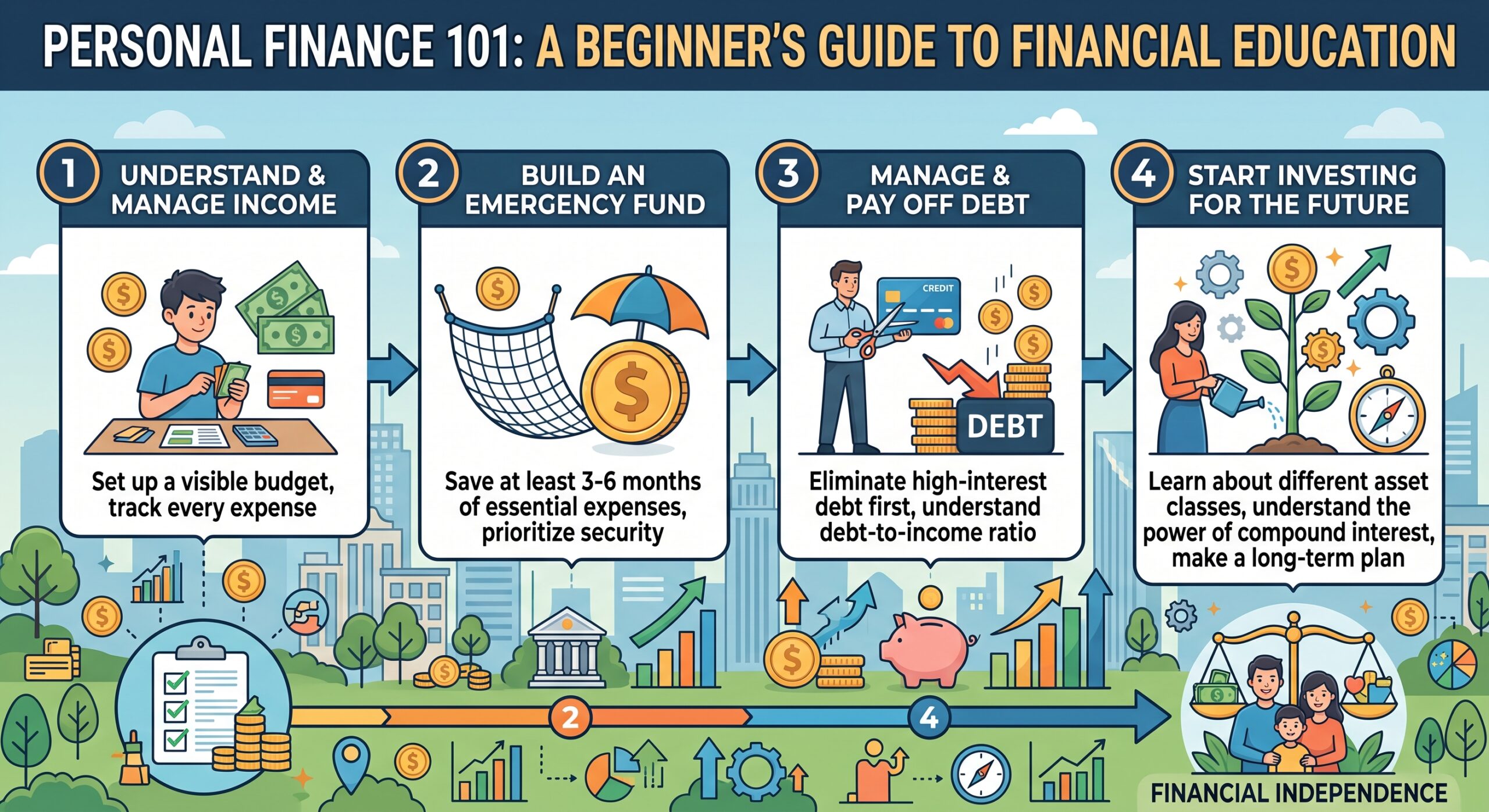
1. Laying the Financial Foundation
Before buying individual stocks or exploring complex assets, you must build a safety net. Without a foundation, a sudden financial shock can force you to liquidate your investments at the worst possible time.
- Establish a “Safe-to-Fail” Emergency Fund: Aim for 3 to 6 months of essential living expenses. Keep these funds in a High-Yield Savings Account (HYSA). This ensures your cash remains liquid (easily accessible) while earning competitive interest to fight inflation.
- Tackle High-Interest Debt first: Not all debt is equal. Credit card debt or personal loans with interest rates above 7-8% act as a “negative investment.” Paying them off guarantees a return equivalent to that high interest rate.
- Create a Realistic Budget: Use simple frameworks like the 50/30/20 rule:
- 50% for Needs (rent, groceries, utilities).
- 30% for Wants (dining out, hobbies, travel).
- 20% for Savings and Investments.
2. Core Investment Strategies for Early Career Success
When it comes to investing, your greatest asset is time. Thanks to the power of compounding interest, a dollar invested in your early twenties is worth far more than a dollar invested in your late thirties.
What is Compounding Interest?
It is the process where your investment’s earnings are reinvested to generate their own earnings. Over decades, this exponential growth turns modest contributions into significant wealth.
Consider these core investment vehicles:
The “Free Money” Match: Employer-Sponsored Plans
If your company offers a 401(k) or equivalent retirement plan with an employer match, always contribute at least enough to get the full match. If your employer matches 100% of your contributions up to 3% of your salary, that is an immediate 100% return on your investment before the market even moves.
Broad-Market Index Funds and ETFs
For young professionals, trying to pick the next “viral” stock is a risky gamble. Instead, look to low-cost index funds or Exchange-Traded Funds (ETFs) that track broad markets, such as the S&P 500 or total global stock indices.
- Diversification: An index fund buys you a tiny slice of hundreds of companies, reducing the risk of a single business failing.
- Low Fees: Look for funds with low expense ratios (ideally under 0.1%). High fees quietly eat away at your compounding growth over time.
Dollar-Cost Averaging (DCA)
Don’t try to time the market. Instead, practice Dollar-Cost Averaging—investing a fixed amount of money at regular intervals (e.g., $200 every payday), regardless of whether the market is up or down. When prices are high, your money buys fewer shares; when prices drop, your money buys more.
3. Passive and Active Income Tips
Investing your existing money is only half of the wealth equation. To accelerate your progress, find ways to increase the total pool of capital you have available to invest.
| Income Stream | Effort Level | Primary Benefit |
| Primary Career Growth | High | Highest long-term earning potential and stability. |
| Skill-Based Side Hustles | Medium-High | Direct monetization of existing talents (freelancing, consulting). |
| Digital Products / Content | High (Initial) / Low (Ongoing) | Scalable, highly passive income over time. |
| Dividend Stocks / Real Estate (REITs) | Low | Automated, hands-off income from invested capital. |
Tip A: Maximize Your Primary Career
The highest-return investment you can make is in yourself. Negotiating a 10% raise or earning a certification that qualifies you for a promotion generates immediate capital that you can funnel directly into your investment portfolio.
Tip B: Monetize High-Value Skills
If you have skills in writing, coding, graphic design, or digital marketing, utilize freelance platforms to build a secondary income stream. Funneling 100% of your “side hustle” earnings into investments can cut years off your retirement timeline.
Tip C: Explore Passive Vehicles (REITs)
If you want exposure to real estate but do not have the capital or time to manage physical property, look into Real Estate Investment Trusts (REITs). REITs are companies that own or finance income-producing real estate. They are bought and sold on major stock exchanges and are legally required to distribute a large portion of their taxable income to shareholders as dividends.
4. Pitfalls to Avoid as a Young Investor
When starting out, emotional decisions can easily derail years of disciplined saving. Avoid these common traps:
- Chasing Hype and Speculation: Avoid allocating a large portion of your portfolio to volatile, unproven trends (like meme stocks or speculative crypto). Keep high-risk speculative plays to a small “fun money” slice of your portfolio (under 5%).
- Panic Selling During Downturns: Stock markets move in cycles. Historically, every major market decline has been followed by a recovery and subsequent growth. When the market dips, look at it as a clearance sale to buy quality assets at a discount, rather than a reason to sell at a loss.
- Lifestyle Creep: As your income increases, resist the urge to scale up your spending at the exact same rate. If you receive a raise, allocate half of the increase directly to your automated savings before you get used to seeing it in your checking account.
Summary: The Power of Consistency
Building wealth is rarely about a single lucky investment. It is the result of consistent, daily habits: budgeting mindfully, automating your savings, investing in diversified index funds, and continuously finding ways to grow your professional value. Start small, stay consistent, and let time do the heavy lifting.
Disclaimer: This article is for informational and educational purposes only and should not be construed as professional financial, investment, or legal advice. Always consult with a licensed financial advisor or conduct thorough personal research before making significant financial decisions.