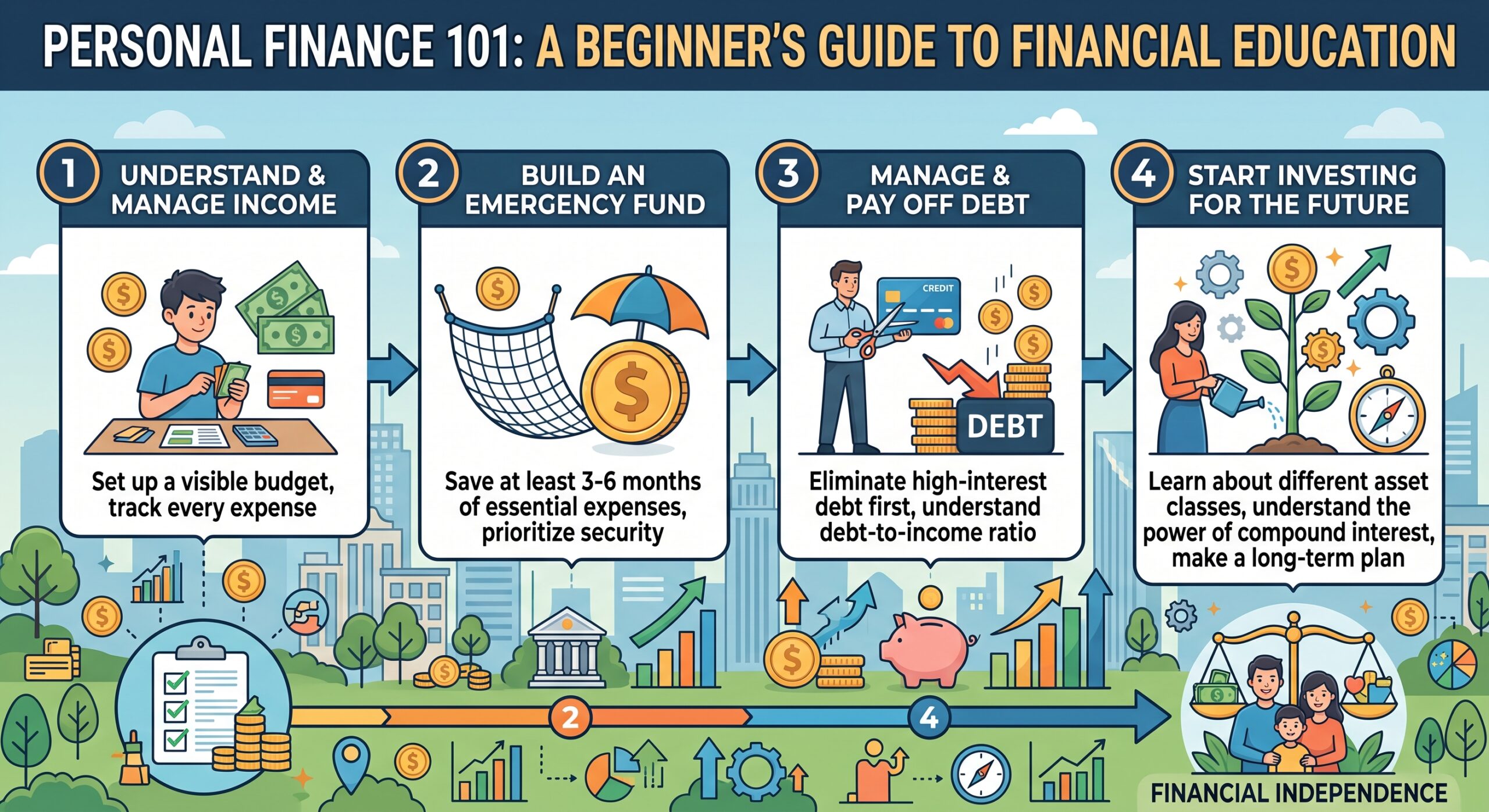

Building a secure financial future is much like constructing a residential building; it requires a rock-solid foundation, a resilient framework, and a strategy to weather unexpected economic storms. In an era marked by shifting market dynamics, fluctuating inflation, and evolving pension systems, relying solely on traditional savings accounts is no longer enough to guarantee long-term financial freedom.
Achieving a secure future demands a proactive approach to investments and strategic income planning. This comprehensive guide explores the core principles of wealth accumulation, portfolio diversification, and the transition from growing assets to generating sustainable lifestyle income.
1. The Foundation: Understanding Risk, Reward, and Time
Before allocating capital into any financial vehicle, it is crucial to understand the fundamental relationship between risk and reward. In finance, risk and potential return move in tandem: higher returns generally require accepting greater volatility.
Low Risk (e.g., Treasury Bonds)  ---> Lower Potential Return
High Risk (e.g., Growth Stocks)  ---> Higher Potential Return
However, the ultimate equalizer in investment planning is time. Thanks to the power of compounding interest, starting early can dramatically alter a financial trajectory. When returns earn returns, wealth grows exponentially rather than linearly.
The Rule of 72
To visualize how quickly wealth can double through compounding, investors often use a simple formula known as the Rule of 72. By dividing 72 by the expected annual rate of return ($r$), you can estimate the number of years ($t$) it will take for an initial investment to replicate itself:
$$t = \frac{72}{r}$$
For instance, an investment with an $8\%$ annual return will double your capital in approximately $9$ years. This mathematical reality highlights why time in the market is vastly more important than trying to time the market.
2. Strategic Asset Allocation and Portfolio Diversification
Diversification is often called the “only free lunch” in investing. It is the practice of spreading investments across various asset classes to reduce exposure to the volatility of any single asset. A well-rounded portfolio typically balances several distinct categories:
Equities (Stocks)
Equities represent ownership shares in companies. Historically, stocks have offered the highest long-term returns, making them the primary engine for capital growth. While they are prone to short-term market corrections, their long-term trajectory has consistently outpaced inflation. Investors can choose between broad-market index funds, individual blue-chip equities, or sector-specific Exchange-Traded Funds (ETFs).
Fixed-Income (Bonds)
Bonds are essentially loans made to corporations or governments that pay a fixed rate of interest over a specific period. They provide stability and predictable cash flow, acting as a cushion when equity markets experience a downturn.
Alternative Assets
For sophisticated portfolios, alternative investments offer low correlation to traditional stock and bond markets, providing an excellent hedge against systemic shocks.
- Real Estate: Provides both potential capital appreciation and steady rental income.
- Tangible and Sustainable Assets: Investing in managed timberland, clean energy infrastructure, or agricultural land offers unique advantages. These assets inherently possess intrinsic value, track positively with inflation, and align with global shifts toward sustainability.
Cash Equivalents
High-yield savings accounts and money market funds offer maximum liquidity and safety, ideal for emergency funds but poorly suited for long-term growth due to inflation risk.
3. Designing an Income Planning Blueprint
While the first phase of your financial journey focuses on asset accumulation, the ultimate goal is income planning—the process of structuring assets to systematically replace a primary professional income. A successful income plan must address three distinct risks: market volatility, inflation, and longevity (the risk of outliving your money).
The Bucket Strategy for Cash Flow
A highly effective method for managing income in later stages of life is the “Bucket Strategy,” which divides total wealth into three distinct horizons:
| Bucket | Time Horizon | Investment Profile | Purpose |
| Bucket 1: Immediate | 1 to 3 Years | Cash, Short-term CDs, Money Market Funds | Covers daily living expenses and structural needs, ensuring you never have to sell equities during a market crash. |
| Bucket 2: Medium-Term | 3 to 7 Years | Dividend-paying stocks, High-quality Corporate Bonds, REITs | Focuses on capital preservation with a secondary goal of income generation to replenish Bucket 1. |
| Bucket 3: Long-Term | 7+ Years | Growth Equities, Alternative Assets, Sustainable Investments | Focused entirely on capital growth to beat inflation and ensure the portfolio’s longevity. |
4. Navigating Macroeconomics and Inflation
No investment strategy exists in a vacuum. Macroeconomic factors, particularly central bank monetary policies and inflation cycles, heavily dictate asset performance.
Inflation quietly erodes the purchasing power of fiat currency. If a portfolio generates a $5\%$ nominal return in a year where inflation runs at $4\%$, the real return is a mere $1\%$. Therefore, an income plan must intentionally include assets that thrive in inflationary environments.
Real estate typically allows for upward rent adjustments, commodities increase in value, and companies with strong pricing power can pass rising costs onto consumers, preserving their profit margins and dividend payouts. Keeping a close eye on interest rate cycles also helps determine when to lock in long-term yields on fixed-income assets.
5. Risk Management and Digital Security
In the modern financial landscape, protecting wealth is just as critical as building it. A robust financial plan is incomplete without comprehensive risk management, which spans insurance policies, tax optimization, and rigorous digital cybersecurity.
As financial management migrates entirely to digital platforms, investors face increasingly sophisticated threats. Phishing scams, identity theft, and AI-driven financial fraud are rising globally. Protecting your investments requires a multi-layered security approach:
- Utilize dedicated, hardware-based Multi-Factor Authentication (MFA) for all brokerage and banking access.
- Implement frozen credit profiles to prevent unauthorized accounts from being opened in your name.
- Be cautious of social engineering tactics and unverified financial opportunities that promise anomalous, guaranteed yields.
Furthermore, structuring assets within tax-advantaged accounts (such as 401ks, IRAs, or local tax-incentivized structures) ensures that a significant portion of your hard-earned compounding returns is kept away from unnecessary taxation.
Conclusion: Commitment to the Long Game
Securing your financial future is not a one-time event, but an ongoing process of refinement. It requires the discipline to maintain consistent investment habits, the patience to allow compound interest to work, and the agility to adapt to macroeconomic shifts.
By diversifying across traditional and alternative asset classes, building a structured income plan, and safeguarding your digital footprint, you turn future uncertainties into manageable variables. The best time to start planning was years ago; the second best time is today. Take control of your allocation, stay informed, and build a legacy that stands the test of time.