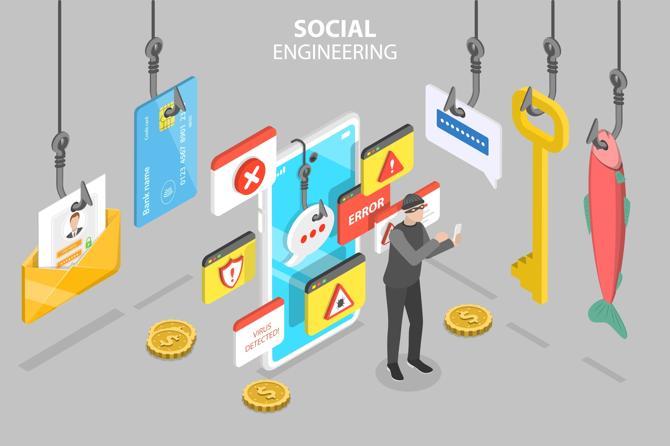
In the rapidly evolving landscape of 2026, the financial sector remains the most lucrative target for cybercriminals. While banks and fintech institutions spend billions on firewalls, encryption, and blockchain security, a fundamental vulnerability remains: the human factor. Social engineering—the psychological manipulation of individuals into performing actions or divulging confidential information—has become the primary entry point for modern financial breaches.
As traditional hacking methods (like brute-forcing passwords) become less effective against robust AI-driven defenses, attackers have pivoted to “hacking the human.” This article explores the sophisticated social engineering tactics currently threatening the financial sector and the strategic frameworks necessary to mitigate these risks.
The Evolution of Deception: 2026 Trends
Social engineering is no longer limited to poorly written “Nigerian Prince” emails. Today, it is a high-tech, industrialized operation.
1. AI-Powered Deepfakes and Vishing
The most significant shift in 2026 is the integration of Generative AI. Attackers now use voice cloning and video deepfakes to execute highly convincing “Vishing” (voice phishing) attacks. An employee in a bank’s treasury department might receive a video call from someone who looks and sounds exactly like the CFO, requesting an “urgent and confidential” wire transfer to close a time-sensitive acquisition. These attacks bypass traditional “know your colleague” instincts because the sensory data—the voice and the face—appear legitimate.
2. Hyper-Personalized Spear Phishing
Gone are the days of mass-market spam. Modern attackers perform extensive reconnaissance using “Open Source Intelligence” (OSINT). By scraping professional networks and corporate websites, they craft “Spear Phishing” emails that reference real projects, specific software the bank uses, or even recent internal company events. This level of detail builds immediate trust, making the victim far more likely to click a malicious link or download a “report” that contains a remote access trojan (RAT).
3. “Quishing” and QR Code Exploitation
The ubiquity of QR codes has birthed “Quishing.” Fraudsters place malicious QR codes in physical banking lobbies or send them via digital invoices. When scanned, these codes redirect users to cloned “look-alike” portals designed to harvest Multi-Factor Authentication (MFA) tokens in real-time. This allows attackers to bypass even advanced security layers by tricking the user into authorizing the session themselves.
Psychological Triggers: Why These Attacks Work
Social engineers do not rely on technical glitches; they rely on cognitive biases. Understanding these triggers is essential for any financial professional.
- Authority: People are conditioned to obey leadership. By impersonating regulators or executives, attackers create a sense of duty that overrides standard verification protocols.
- Urgency: “The account will be frozen in 30 minutes” or “The merger will fail if this isn’t sent now.” Urgency causes the brain to switch from analytical thinking to emotional reacting.
- Fear: In the financial sector, the fear of non-compliance or a security breach is a powerful motivator. Attackers often pose as “Security Alerts” to trick users into “fixing” a problem that doesn’t exist.
- Helpfulness: Many bank employees pride themselves on customer service. Social engineers exploit this by posing as distressed customers who “forgot” their credentials or need urgent help accessing their funds.
The Financial Impact: Beyond the Bottom Line
The cost of a successful social engineering attack in the financial sector is astronomical. In 2026, the average cost of a breach for a major bank often exceeds $6 million, but the financial loss is only the beginning.
| Impact Category | Description |
| Direct Capital Loss | Stolen funds from unauthorized wire transfers or “mule” accounts. |
| Regulatory Fines | Penalties for failing to protect sensitive customer data (GDPR, CCPA, etc.). |
| Reputational Damage | Loss of customer trust, leading to account closures and a drop in stock value. |
| Operational Downtime | Costs associated with forensic investigations and system restoration. |
Defense Strategies for 2026
To combat these threats, financial institutions must move beyond simple “compliance training” and adopt a multi-layered, Zero Trust approach.
1. Continuous Behavioral Authentication
Instead of relying on a single login event, banks are moving toward Continuous Authentication. This technology uses AI to monitor user behavior throughout a session—analyzing typing speed, mouse movements, and navigation patterns. If a “user” suddenly starts performing high-risk actions that don’t match their historical profile, the system can automatically freeze the session.
2. The “Double-Channel” Verification Rule
Financial institutions should mandate a “Double-Channel” rule for any transaction above a specific threshold or any change in vendor payment details. If an email request comes in, it must be verified via a separate, pre-approved channel (like a direct phone call to a known number or an internal secure messaging app) before action is taken.
3. Adaptive Security Awareness Training
Static annual training is obsolete. Modern training involves Live Simulations. Security teams send “fake” phishing emails and place “fake” vishing calls to employees. Those who fall for the simulation receive immediate, “just-in-time” coaching. This builds “muscle memory” and keeps security at the top of mind.
4. Hardening Public Information
Banks must be disciplined about what information they share publicly. Leadership profiles should avoid overly personal details that can be used in “pretexting,” and job postings should not list specific security software versions, as this gives attackers a roadmap of the bank’s internal tech stack.
Conclusion
In the financial sector, social engineering is the ultimate “low-cost, high-reward” tactic for criminals. As AI makes deception more realistic, the boundary between legitimate and fraudulent communication will continue to blur.
The most effective defense is not a better firewall, but a culture of skepticism. When financial institutions empower their employees to question authority, verify through multiple channels, and prioritize security over speed, they turn their greatest vulnerability into their strongest shield.
Would you like me to generate a 5-question quiz based on this article to test employee awareness?