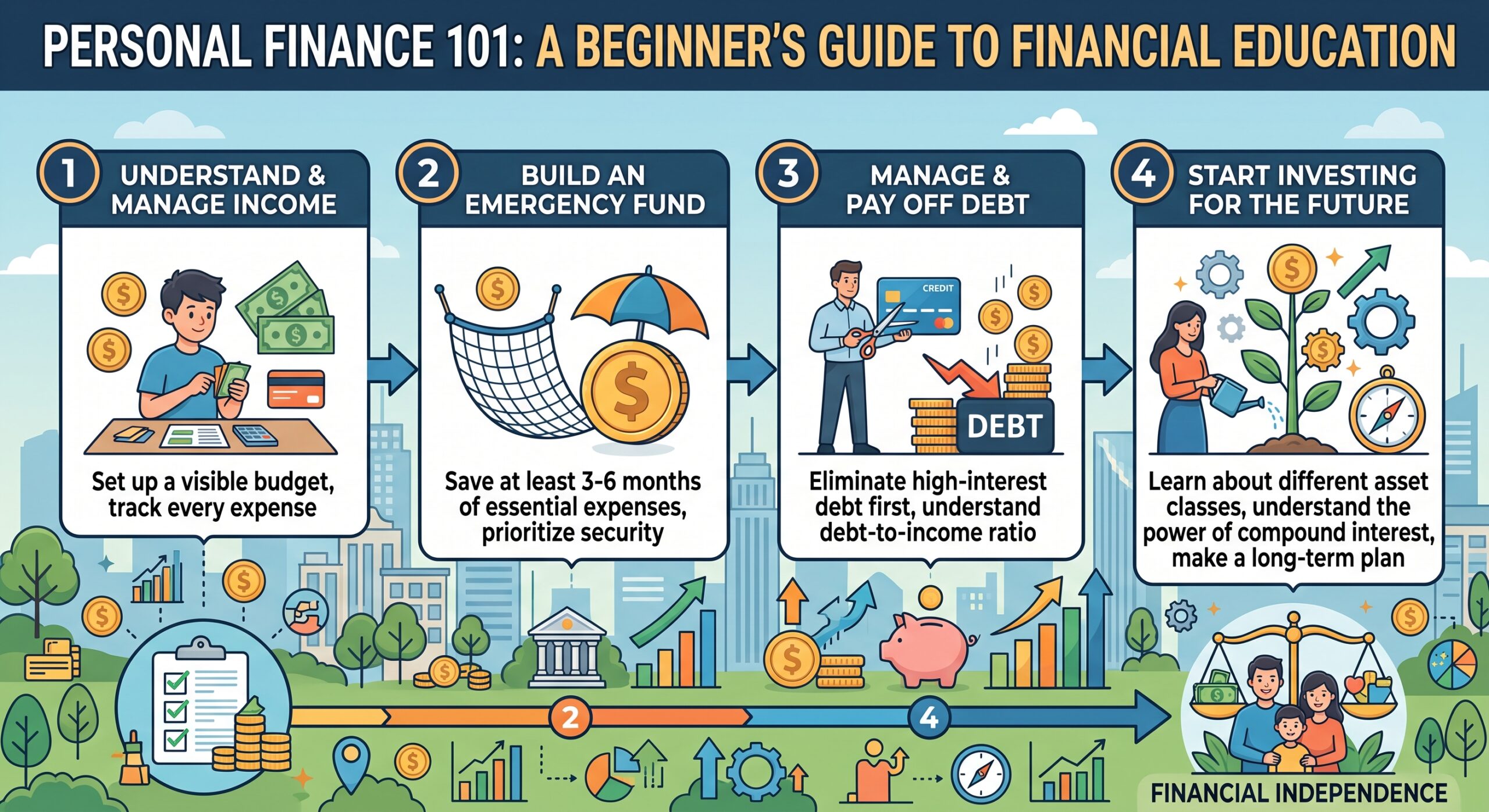

Entering the world of investing can feel like stepping into a foreign country without a map. The financial landscape is filled with complex jargon—bull markets, dividend yields, expense ratios, and asset allocation—that can easily intimidate anyone looking to grow their money.
However, ignoring the investment world is one of the costliest mistakes you can make. Leaving your hard-earned money strictly in a traditional savings account means losing purchasing power over time due to inflation. To build true, long-term wealth, you need your money to work for you.
This comprehensive guide breaks down the core investment vehicles every beginner must understand, how to balance risk, and how to start building a portfolio today.
1. The Core Concept: Risk vs. Reward
Before buying your first asset, you must understand the golden rule of investing: the relationship between risk and return.
In the financial markets, higher potential returns always come with higher risk. If an investment promises massive gains with zero risk, it is likely a scam or highly speculative.
- Low Risk: Your capital is relatively safe, but growth will be slow (e.g., government bonds, high-yield savings accounts).
- High Risk: Your capital could fluctuate wildly, meaning you could lose money in the short term, but the long-term growth potential is substantial (e.g., individual stocks, cryptocurrency).
Understanding your personal risk tolerance—how much market volatility you can stomach without panicking—is the first step to becoming a successful investor.
2. Stocks: Owning a Piece of a Company
When you buy a share of stock (also known as equity), you are purchasing a tiny fraction of ownership in a public corporation.
If Apple, Microsoft, or Amazon generates a profit and expands, the value of your share typically goes up. Conversely, if the company struggles, your share value decreases.
How You Make Money with Stocks:
- Capital Gains: Buying a stock at a low price and selling it later at a higher price.
- Dividends: Some established companies distribute a portion of their earnings back to shareholders on a regular basis (usually quarterly).
Beginner Tip: Investing in individual stocks requires deep research, financial literacy, and time. For beginners, buying single stocks can be highly risky because your success is tied to one company’s performance.
3. Bonds: Lending Your Money for Interest
If stocks represent ownership, bonds represent debt. When you buy a bond, you are essentially lending money to an entity—usually a government or a corporation. In exchange for your loan, they promise to pay you back the principal amount on a specific date (the maturity date), plus regular interest payments along the way.
Types of Bonds:
- Government Bonds: Backed by national governments (like US Treasuries). They are considered among the safest investments in the world, though they offer lower returns.
- Corporate Bonds: Issued by companies. They carry a bit more risk than government bonds but offer higher interest rates to compensate.
Bonds provide stability and reliable income to an investment portfolio, acting as a cushion when the stock market gets rocky.
4. Mutual Funds and ETFs: The Power of Diversification
If buying individual stocks and bonds sounds overwhelming, you are not alone. This is where Mutual Funds and Exchange-Traded Funds (ETFs) come in. They are the ultimate tools for beginners.
Imagine a basket filled with hundreds of different stocks and bonds. When you buy a share of that basket, you instantly own a tiny piece of everything inside it. This is called diversification, and it is the best way to manage risk. If one company in the basket goes bankrupt, your overall portfolio barely feels it because the other 99 companies keep it afloat.
Mutual Funds vs. ETFs: What’s the Difference?
| Feature | Mutual Funds | ETFs (Exchange-Traded Funds) |
| How They Trade | Traded once a day after the market closes. | Traded throughout the day like regular stocks. |
| Management Style | Often actively managed by a professional fund manager. | Often passively managed, tracking a specific index. |
| Fees (Expense Ratios) | Typically higher due to active management. | Typically very low. |
| Minimum Investment | Often requires a flat minimum (e.g., $1,000+). | Can be purchased for the price of a single share. |
The Beginner’s Best Friend: Index Funds
An index fund is a type of ETF or mutual fund that automatically tracks a market index, like the S&P 500 (which represents the 500 largest publicly traded companies in the United States). Instead of trying to “beat the market,” index funds simply mirror it. Historically, the S&P 500 has delivered an average annual return of around 10% over the long term, making index funds a highly recommended starting point for new investors.
5. Real Estate: Beyond Buying a House
Real estate is a classic wealth-building asset class, but traditional property investing requires massive capital, maintenance, and landlording duties.
For beginners, the easiest entry point into real estate is through REITs (Real Estate Investment Trusts). REITs are companies that own, operate, or finance income-producing real estate (like apartment buildings, shopping malls, or hospitals). They trade on stock exchanges just like regular stocks, and by law, they must distribute at least 90% of their taxable income to shareholders in the form of dividends.
6. The Magic of Compound Interest
The most powerful tool an investor has is not money—it is time. Thanks to compound interest, the money you invest earns returns, and then those returns earn their own returns.
If you invest $100 and earn a 10% return, you have $110. The next year, you earn 10% on $110, which is $11, bringing your total to $121. Over 20, 30, or 40 years, this snowball effect transforms small, consistent contributions into massive fortunes.
$$A = P \left(1 + \frac{r}{n}\right)^{nt}$$
The mathematical formula for compound interest illustrates how time ($t$) exponentially scales your total accumulated wealth ($A$) relative to your principal ($P$). The takeaway for beginners is simple: start as early as possible, even if you only have a small amount of money to invest.
How to Start Investing Today: A 3-Step Action Plan
- Build an Emergency Fund First: Never invest money you might need next month. Before putting a single dollar into the market, ensure you have 3 to 6 months’ worth of living expenses safely tucked away in a High-Yield Savings Account (HYSA).
- Open a Brokerage Account: To buy stocks, ETFs, or mutual funds, you need an account with a regulated financial institution. Look for reputable, low-fee brokerages that offer fractional shares (allowing you to buy portions of a stock if you can’t afford the full share price).
- Automate Your Investments: The easiest way to build wealth is through Dollar-Cost Averaging. Set up an automatic transfer every month or paycheck to buy your chosen ETFs. This removes emotion from investing; you buy fewer shares when prices are high and more shares when prices are low.
Conclusion
Investing is a marathon, not a sprint. The goal is not to get rich overnight through speculative bets, but to consistently buy high-quality assets that grow in value over decades. By focusing on low-cost index funds, maintaining a diversified portfolio, and letting compound interest do the heavy lifting, you will set yourself on a clear path toward financial freedom.