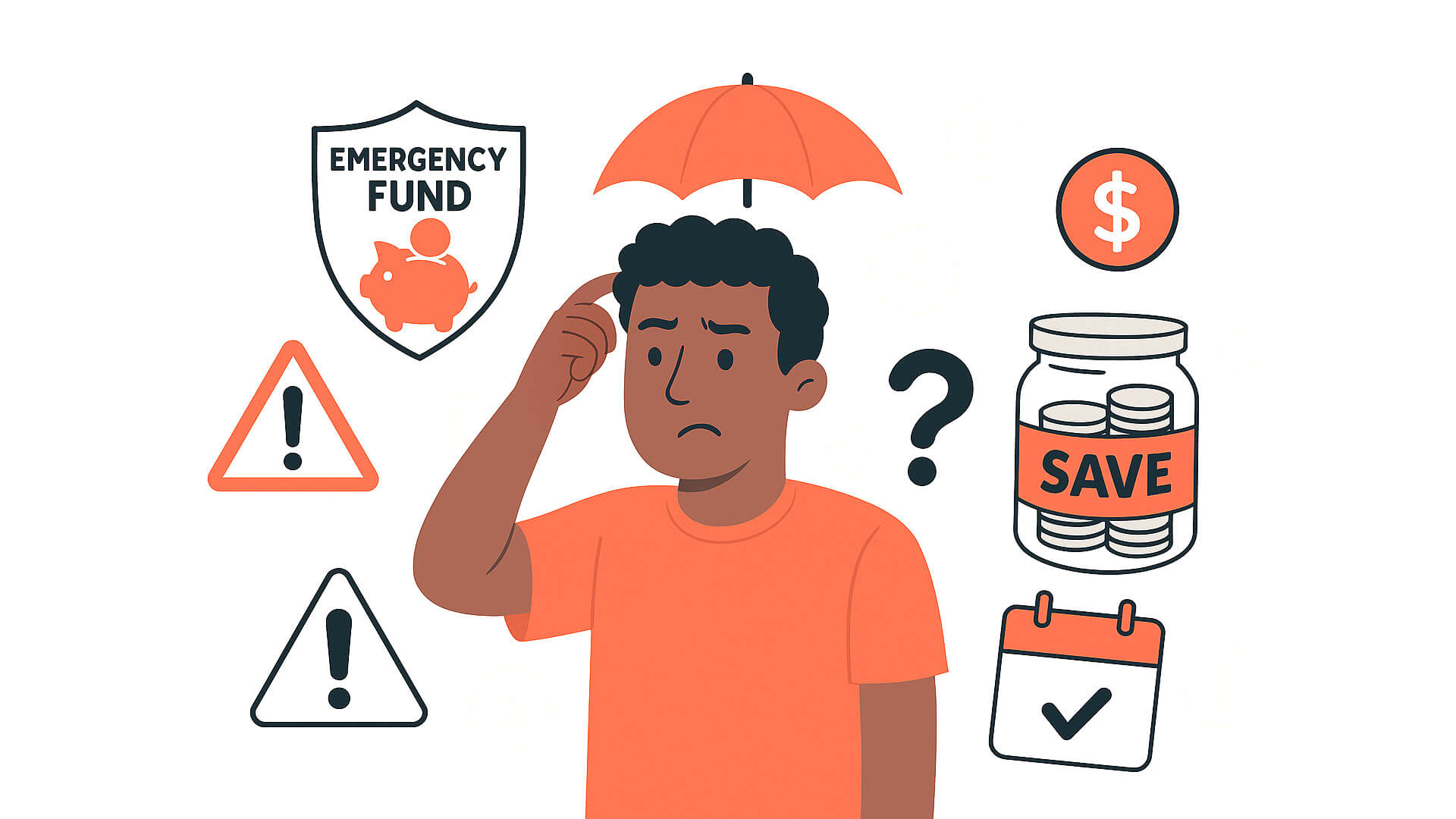
In the complex landscape of personal finance, one question consistently stands out: “How much should I save for emergencies?”
The answer isn’t a simple one-size-fits-all number. It’s a highly personal calculation that depends on your income stability, monthly expenses, job security, and family situation. This detailed guide will break down the conventional rules, help you determine your ideal savings target, and provide actionable steps to build and maintain your emergency fund.
🎯 The Golden Rule: 3 to 6 Months of Expenses
The standard advice given by financial planners, and a great starting point for nearly everyone, is to save enough money to cover three to six months of your essential living expenses.
This range acts as a robust financial buffer, designed to sustain you and your family through common financial shocks, such as:
- Job Loss: Providing several months to search for a new position without panic.
- Medical Emergencies: Covering high-deductible costs or unexpected treatment.
- Major Home/Car Repairs: Paying for a new roof, furnace, or engine replacement.
Calculating Your Target
To find the value of your emergency fund, you must first calculate your Monthly Essential Expenses (MEE). This is not your total monthly spending, but the minimum required to keep your life functioning.
- Include: Rent/Mortgage, utilities (gas, electric, water), food/groceries, minimum debt payments, necessary insurance premiums, and transportation costs.
- Exclude: Discretionary spending like dining out, entertainment subscriptions, shopping, and non-essential travel.
Example: If your MEE is $3,000, your emergency fund target should be:
- Minimum (3 months): $\$3,000 \times 3 = \mathbf{\$9,000}$
- Optimal (6 months): $\$3,000 \times 6 = \mathbf{\$18,000}$
⚖️ Customizing Your Emergency Fund: When to Save More or Less
While 3-6 months is the baseline, you should adjust this figure based on your personal risk profile. Your emergency fund should be scaled inversely to your financial stability.
Save More (9 to 12+ Months) if You Are:
| Financial Profile | Rationale |
| Self-Employed/Freelancer | Income is irregular and unpredictable. A client leaving can mean a 3-month gap in pay. |
| Sole Earner | If your household relies entirely on your single income, the risk of a job loss is higher for the whole family. |
| In a Volatile Industry | Industries prone to mass layoffs, economic downturns, or rapid technological change (e.g., hospitality, certain tech sectors). |
| High Health Risks/Dependent | If you or a family member has a chronic condition or high potential for large medical bills. |
| High-Cost of Living Area | It often takes longer to find a comparable, well-paying job in a competitive, expensive city. |
Save Less (3 Months Minimum) if You Are:
| Financial Profile | Rationale |
| Dual-Income Household | If one person loses their job, the other’s income can partially cover expenses. |
| High Job Security | Working for a stable government agency, an essential service (like a utility company), or in a role with consistently high demand. |
| Minimal Debt/No Mortgage | Lower mandatory expenses reduce the cash needed to stay afloat. |
| Excellent Access to Credit | While not a replacement for cash, a reliable, low-interest line of credit can provide an absolute last resort. |
The most crucial takeaway: Do not drop below the three-month minimum. It’s the floor of your financial safety net.
🗄️ Where Should the Money Go? Liquidity is Key
The location of your emergency savings is just as important as the amount. The funds must be liquid (easily accessible) and safe. This is not an investment fund, so the primary goal is not high returns—it’s preservation of capital.
The Best Homes for Your Emergency Fund
- High-Yield Savings Accounts (HYSAs):
- Pros: Federally insured (FDIC or NCUA), highly liquid (can withdraw instantly), and offer a much better interest rate than traditional checking or savings accounts.
- Cons: Returns rarely outpace inflation, but this is an acceptable trade-off for safety.
- Money Market Accounts (MMAs):
- Pros: Similar to HYSAs, offering competitive interest and check-writing privileges.
- Cons: Often require a higher minimum balance to earn the best rates.
The Worst Homes for Your Emergency Fund (Avoid These)
- The Stock Market/Individual Stocks: Too volatile. A major emergency (like a recession) is often the worst time to sell investments.
- Retirement Accounts (401k/IRA): Withdrawing early incurs substantial penalties (usually 10%) and regular income tax, defeating the purpose of an emergency fund.
- Your Checking Account: Too accessible. You are more likely to spend the money accidentally on non-emergencies.
🧱 A Step-by-Step Plan for Building Your Fund
Building a 6-month fund can feel overwhelming, especially if you’re starting from scratch. Here is a practical, phased approach.
Phase 1: The $\$1,000$ Starter Fund (1-3 Weeks)
Your first goal is to save $1,000. This covers minor emergencies like a flat tire, a minor medical co-pay, or a broken appliance. Achieving this quickly creates momentum and psychological security.
- Action: Find quick cash by selling unused items, working extra hours, or cutting all non-essential spending for one pay cycle (a “savings sprint”).
Phase 2: The 3-Month Minimum (3-6 Months)
Once the $\$1,000$ is secure, pivot your focus to hitting the minimum 3-month target.
- Action: Treat your savings contribution like any other non-negotiable bill (rent, utilities). Set up an automatic transfer from your checking account to your HYSA on payday. Even small, consistent amounts will accumulate quickly.
Phase 3: The Full 6-12 Month Fund (6-18 Months)
Now you are optimizing for complete financial peace. Every extra dollar saved beyond the 3-month mark goes into this ultimate buffer.
- Action: Use “windfalls” to accelerate your savings. This includes tax refunds, work bonuses, or inheritance. Resist the urge to spend these funds.
🔧 Maintaining and Replenishing Your Fund
An emergency fund isn’t a one-time project; it’s a financial appliance that needs occasional use and repair.
When to Use It (It Must Be a True Emergency)
Use your fund only for truly unexpected and necessary expenses. If you can predict or budget for an expense, it is not an emergency.
| ✅ Appropriate Use | ❌ Inappropriate Use (Should Be Budgeted) |
| Your roof leaks after a storm. | Paying for Christmas presents. |
| You lose your job. | Going on vacation. |
| Your pet needs unexpected surgery. | A planned car upgrade. |
| Your insurance deductible for an accident. | Buying new clothes for a new season. |
The Replenishment Rule
If you are forced to use your emergency fund, your immediate financial priority must be to replenish it back to its target amount. Stop non-essential investing (after meeting employer matches) and temporarily pause debt acceleration until the fund is whole again.
🚀 Conclusion
The question “How much should I save for emergencies?” is a foundational element of sound personal finance. By calculating your Monthly Essential Expenses, determining your personal risk profile to set a 3 to 12-month target, and keeping the funds safe and liquid in a High-Yield Savings Account, you create a fortress around your financial future.
This emergency fund is more than just money; it’s freedom—the freedom to make rational decisions during a crisis, the freedom to leave a bad job, and the freedom from high-interest debt when disaster strikes.